Last updated: October 26, 2026. Market data as of October 26, 2026; dollar values use bitcoin’s October 25, 2026 close of $80,053.
Short answer: A bitcoin layer 2 (often called a bitcoin L2) is a separate system built on top of the bitcoin blockchain to make payments faster and cheaper. The main one is the Lightning Network, which moves bitcoin through payment channels for about a cent on a $100 payment. Others, like Liquid, Rootstock and Stacks, are separate chains where a group of signers holds the real bitcoin. Newer rollups like Citrea use a bridge (the system that holds your real bitcoin) that needs only one honest participant. Before you use any of them, ask one question: if the operator disappears, can you get your bitcoin back on your own?
Key takeaways
- Why layer 2s exist: bitcoin adds a block about every 10 minutes and handles only a few transactions per second.
- Lightning is the main payment layer: 2,571 BTC in public channels and 15,255 nodes on October 21, 2026, per mempool.space, down about 38% in a year. A typical routing fee is 0.01% of the payment per hop.
- Most other “layer 2s” rely on signers: Liquid’s bitcoin is controlled by 11 of 15 signers, and Stacks’ sBTC by 15 signers with a 70% threshold.
- It has gone wrong: on September 6, 2026, a software bug let an attacker pull about 4,000 BTC (about $320 million) out of Liquid’s bridge. About 3,400 BTC came back; roughly 600 BTC is still missing, and Liquid’s own withdrawals to bitcoin are still restricted.
- Fees on bitcoin itself are low right now: about $0.11 to $0.56 for a simple transaction on October 26, 2026.
What is a bitcoin layer 2?
Layer 1 is the bitcoin blockchain itself. A layer 2 is anything built on top of it that handles transactions somewhere else and settles back to bitcoin. You’ll also see it written as “bitcoin L2.”
Bitcoin’s base layer is slow by design. A new block arrives about every 10 minutes. Each block has limited space, which works out to single-digit transactions per second. That keeps the network easy to verify, but it can’t handle millions of coffee purchases.
When demand spikes, fees jump. On April 20, 2024, the halving block (block 840,000) paid about 37.6 BTC in fees, just over $2.4 million, across 3,050 transactions. That was an extreme case, driven by the launch of Runes tokens. The average fee that whole day hit a record $128, Cointelegraph reported.
Right now it’s calm. On October 26, 2026, mempool.space recommended 1 to 5 sat/vB. A satoshi (“sat”) is 0.00000001 BTC, and a vB (virtual byte) measures transaction size. A simple payment is about 140 vB, so it costs about $0.11 to $0.56. Using a newer address type helps too: SegWit and Taproot addresses make transactions smaller, as our guide to bitcoin address formats explains.
What this means for you: if you send bitcoin once a month, layer 1 is fine. If you want to pay for small things often, or fees spike again, a layer 2 saves money.
The three main types
| Type | Example | Who holds your BTC | Can you exit alone? |
|---|---|---|---|
| Payment channels | Lightning | You, in a self-custody wallet | Yes |
| Sidechain | Liquid, Rootstock, Stacks | A group of signers | No |
| Rollup with a BitVM bridge | Citrea | A bridge that needs one honest participant | Yes, but the design is new |
Scroll the table horizontally to see all columns.
How the Lightning Network works
Lightning lets two people lock bitcoin into a shared wallet (a channel) and then trade balances back and forth instantly, without writing each payment to the blockchain.
Here’s the basic flow:
- You open a channel with an on-chain transaction, for example locking 0.01 BTC.
- Inside the channel, you and the other side sign new balances for each payment. Nothing goes on-chain.
- Payments can hop through other channels to reach someone you don’t have a channel with.
- When you’re done, you close the channel and the final balance settles on bitcoin.
The key safety feature: you can always close the channel on your own and get your bitcoin back on-chain. If the other side tries to cheat with an old balance, the protocol lets you take their funds as a penalty. That works only if your wallet, or a watchtower service watching for you, spots it in time.
Lightning by the numbers
| Measure | Value | Date |
|---|---|---|
| Public capacity | 2,570.50 BTC (about $206 million) | October 21, 2026 |
| A year earlier | 4,123.21 BTC | October 27, 2025 |
| Peak capacity | about 5,600 BTC | December 2025 |
| Public nodes | 15,255 | October 21, 2026 |
| Public channels | 25,211 | October 21, 2026 |
| Median routing fee, per hop | 100 ppm (parts per million, or 0.01%) plus 0.5 sat | October 21, 2026 |
| Monthly volume | $1.17 billion | November 2025 |
Scroll the table horizontally to see all columns.
Public capacity counts only announced channels; private channels aren’t included. The peak is Spark Research’s figure, and monthly volume is from River’s report. Dollar value at $80,053 per BTC, the October 25, 2026 close.
Public capacity fell about 38% in a year, from 4,123 BTC on October 27, 2025 to 2,571 BTC on October 21, 2026, per mempool.space. That’s more than half below the December 2025 peak. Most of the drop came this summer: capacity was 4,789 BTC on June 18, 2026 and 2,433 BTC on August 27, 2026. 1ML, which counts differently, showed a similar 2,454 BTC on October 26, 2026. Meanwhile, large apps have added it: by mid-2025, more than 15% of bitcoin withdrawals from Coinbase used Lightning, per Spark Research. Cash App routes about 1 in 4 of its bitcoin payments over it, per SpendNode.
Worked example: you pay $100 over Lightning through one hop at the median fee of 100 ppm plus 0.5 sat. The fee is about $0.01 plus a fraction of a cent. Each extra hop adds a similar fee. The same payment on-chain cost $0.11 to $0.56 on October 26, 2026.
Lightning’s limits
- Custodial apps: many popular Lightning apps, including exchange apps, are custodial. The company holds the bitcoin, not you.
- Liquidity: to receive money, someone must have funds on your side of a channel. Most wallets handle this for you, for a fee.
- Online requirement: a self-custody Lightning wallet needs to be online to receive payments.
- Closing costs: a forced channel close needs an on-chain transaction and can lock funds for days, sometimes up to two weeks.
- A few big hubs: the top 10 nodes control about 85% of public capacity, per River’s analysis as reported by SpendNode in February 2026.
- Hot wallets: Lightning funds sit on internet-connected nodes. In August 2026, attackers stole merchant funds from Lightning nodes set up with BTCPay Server. We covered the BTCPay Server Lightning exploit. That was a server security failure, not a break in Lightning itself.
Watch out: the “close your channel and walk away” safety only applies to self-custody Lightning wallets. In a custodial app, you’re trusting the company.
Bitcoin sidechains: Liquid, Rootstock and Stacks
A sidechain is a separate blockchain. You send bitcoin to a bridge, and you get a token on the sidechain that’s supposed to be worth 1 BTC. The real bitcoin sits in a wallet controlled by a group of signers. You trust that group.
| Network | What it does | Who holds the real BTC | Size (date) |
|---|---|---|---|
| Liquid (Blockstream) | Fast transfers between exchanges and traders, confidential amounts | 11 of 15 signers (federation) | 4,235 L-BTC backed by 3,632 BTC (October 21, 2026) |
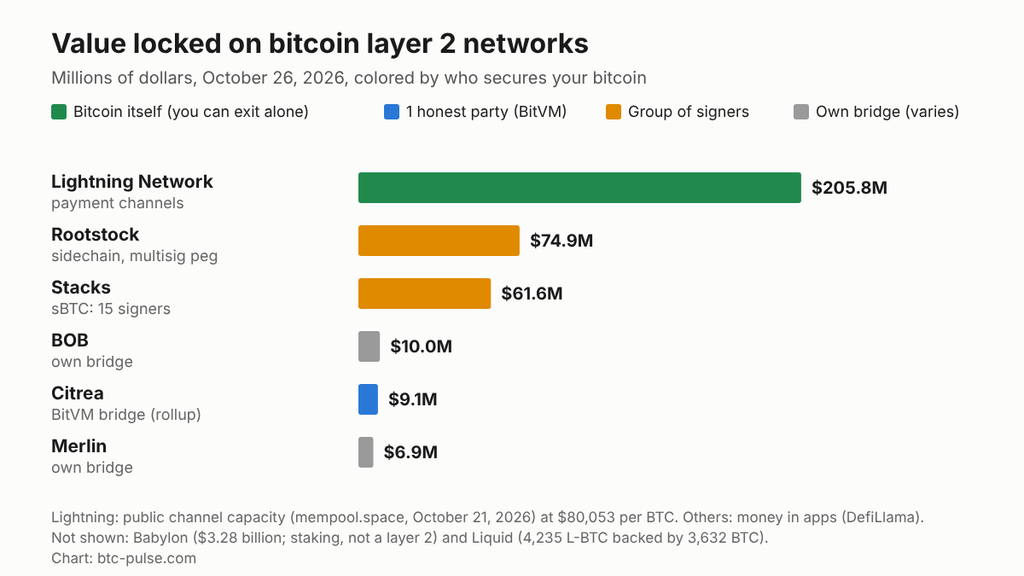
| Rootstock | Smart contracts; miners with 84% of bitcoin’s mining power also mine it (Q2 2026) | A group of signers using special hardware (PowPeg) | $74.9 million in apps (October 26, 2026) |
| Stacks | Smart contracts, sBTC token | 15 signers, 70% threshold | $61.6 million in apps (October 26, 2026) |
Scroll the table horizontally to see all columns.
For Rootstock and Stacks, size is money in apps on each chain (DefiLlama, October 26, 2026), not all bitcoin bridged to it.
Watch out: merged mining sounds like bitcoin-level security. On Rootstock, it protects the blocks and adds a check on withdrawals, because the signing hardware follows only the chain with the most work. But the bitcoin itself still sits in a multisig run by a small, fixed group, so you are still trusting them.
What happened to Liquid in September 2026
On September 6, 2026, an attacker used a bug in Liquid’s software to create about 4,000 unbacked L-BTC and redeem them for real bitcoin, about $320 million. Ledger’s CTO questioned the attacker’s “whitehat” claim. About 3,400 BTC came back the next day. Roughly 598.5 BTC did not.
As of October 21, 2026, reserves were 3,632 BTC against 4,235 L-BTC in circulation, about 603 BTC (14%) short. Direct withdrawals to bitcoin through the federation (peg-outs) are still restricted, with no restart date. The federation says it will restore full backing first. Here’s our report on the Liquid reserve gap.
There is now a way out, but it isn’t the bridge. On October 20, 2026, the SideSwap service started swapping L-BTC for BTC at 1:1 minus a 0.1% fee, paid from its own bitcoin wallet. By October 21 it had handled about 600 swaps worth more than 60 BTC. Big requests wait in a queue until SideSwap refills its wallet, and the swaps don’t close the reserve gap.
No signer keys were stolen. The bug was in the software that checks transactions. That’s the point: a bridge can fail even when the signers do everything right.
What this means for you: on a sidechain, your “bitcoin” is an IOU. If the bridge freezes, you may not be able to turn it back into BTC for weeks.
Rollups and the newest designs
A rollup bundles many transactions off-chain and posts proof of them to bitcoin. The hard part on bitcoin is the bridge, because bitcoin can’t check those proofs directly today.
- Citrea launched its mainnet on January 27, 2026. Its bridge uses BitVM, a method where only one honest participant among the bridge’s operators is needed to stop a bad withdrawal. That’s a big step up from trusting a majority of signers, but it’s new and lightly tested. Value locked: $9.1 million on October 26, 2026.
- Ark lets many users share one on-chain bitcoin transaction. An operator coordinates, but you can exit on-chain on your own, as long as you come online before your coins’ expiry. Ark Labs opened a public beta on October 21, 2025.
- Spark works like a statechain. You and an operator share the keys to a coin, and when the coin changes hands the operator is supposed to delete its old key. You can exit on your own, but you trust that at least one operator really deleted those old keys. It runs with two operators, Lightspark and Flashnet, according to Spark’s own docs (checked October 20, 2026).
- Ethereum-style “bitcoin L2s” (EVM chains) like BOB and Merlin run their own bridges. Their trust setups vary, so check each one.
Babylon is not a layer 2. It lets you stake bitcoin to secure other networks while the BTC stays on bitcoin in a time-locked script. It held $3.28 billion on October 26, 2026, per DefiLlama, down from about $6.38 billion a year earlier.
What this means for you: newer designs promise better exits, but they hold little money and have short track records.
Could bitcoin itself change to help layer 2s?
Some developers want new bitcoin features called covenants. A covenant lets a coin carry rules about how it can be spent next. That would make designs like Ark and BitVM bridges simpler and safer.
As of October 2026, none is active. BIP means Bitcoin Improvement Proposal. The OP_CAT proposal (BIP-347) reached “complete” status on March 1, 2026, but there’s no activation plan. For the CTV proposal (BIP-119), an independent activation client released in February 2026, not part of Bitcoin Core, asks miners to signal between March 30, 2026 and March 30, 2027. It needs 90% of miners. Signaling was 0% in late May 2026, the latest figure we found.
Quick checklist
Ask who holds the BTC: you, one honest participant, or a group of signers?
Check the exit: can you withdraw to bitcoin on your own if the service shuts down?
Compare fees: on-chain fees were $0.11 to $0.56 on October 26, 2026. A layer 2 only saves money when you pay often or fees are high.
Know it’s a hot wallet: layer 2 funds sit on internet-connected systems. Many people keep only spending money there.
Check the bridge’s track record: Liquid’s own withdrawals were still restricted as of October 21, 2026.
FAQ
What is a bitcoin layer 2 in simple terms? It’s a system on top of bitcoin that handles payments or apps off the main chain and settles back to bitcoin. Lightning is the best-known example.
What is the difference between bitcoin layer 1 and layer 2? Layer 1 is the bitcoin blockchain, where every transaction is recorded in a block about every 10 minutes. A layer 2 handles transactions off that chain and settles back to it, which makes small payments faster and cheaper.
Is the Lightning Network safe? The protocol lets you close a channel and take your bitcoin back on-chain on your own. The main risks are wallet and server security, since Lightning funds sit on online nodes. If you use an exchange or custodial app, you’re trusting that company, not the protocol.
What is the biggest bitcoin layer 2? It depends on what you measure. Lightning had 2,571 BTC in public channels on October 21, 2026, and private channels aren’t counted. Liquid had more tokens out, 4,235 L-BTC, but they were backed by only 3,632 BTC on October 21, 2026.
What is a bitcoin sidechain? A separate blockchain that uses a token pegged 1:1 to BTC. The real bitcoin sits with a group of signers, so you trust them rather than bitcoin’s own rules. Liquid, Rootstock and Stacks work this way.
How much does a bitcoin transaction cost on layer 1 right now? On October 26, 2026, mempool.space recommended 1 to 5 sat/vB, which is about $0.11 to $0.56 for a simple transaction. Fees spike when demand jumps, as on April 20, 2024, when the daily average hit a record $128.
Does a layer 2 need its own token? No. Lightning uses bitcoin itself. Liquid and Rootstock use bitcoin-backed tokens (L-BTC, RBTC) rather than a separate coin. Some networks, like Stacks, have their own token in addition to a bitcoin-backed token.
Sources
mempool.space and mempool.space Lightning dashboard (October 26, 2026; Lightning snapshot October 21, 2026) and 1ML: Lightning statistics
Cointelegraph via TradingView: record $2.4M in fees on the halving block (April 20, 2024) and blockchain.com: block 840,000
SpendNode: Lightning hits $1 billion monthly volume, River report (February 19, 2026) and Spark Research: the state of the Lightning Network in 2026 (June 3, 2026)
DefiLlama: chains by value locked and Babylon (October 26, 2026)
The Block: Liquid Network pauses after $320 million withdrawal (September 6, 2026), The Block: attacker says most of 4,000 BTC will be returned (September 7, 2026) and The Defiant: SideSwap reports about 600 redemptions after reopening L-BTC swaps (October 21, 2026)
Rootstock: merged mining report, Q2 2026 and PowPeg docs
Stacks: sBTC FAQ
ForkLog: Citrea launches mainnet (January 27, 2026), The Block: Ark Labs opens Arkade public beta (October 21, 2025) and Spark: operator trust assumptions
Spark Research: bitcoin covenant activation path (August 3, 2026)
This article is for informational purposes only and is not investment advice.