
Last updated: October 15, 2026.
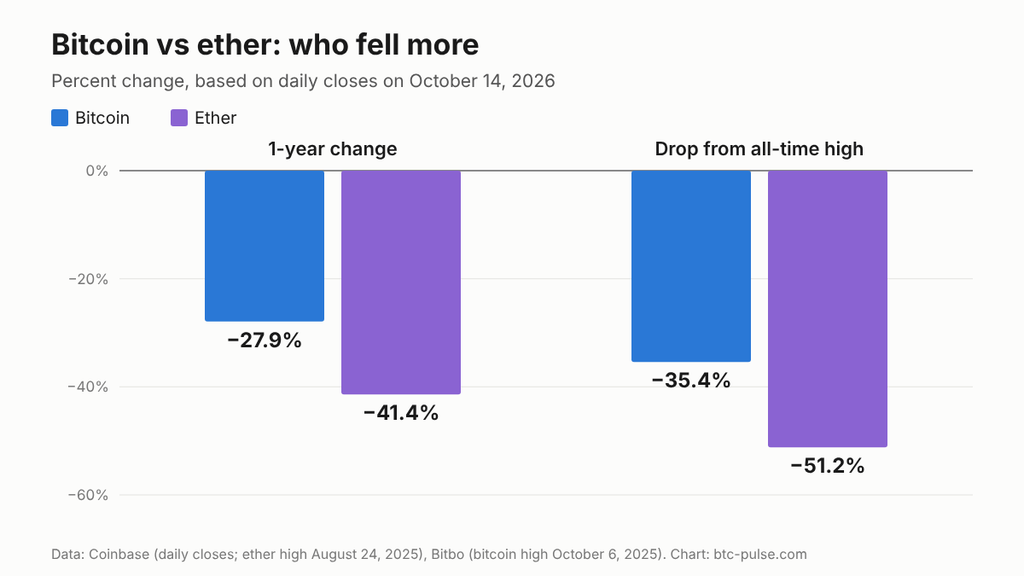
Short answer: Bitcoin is digital money with a hard cap of 21 million coins. Ethereum is a network for running apps, and its coin, ether (ETH), has no fixed cap. Over the year to October 14, 2026, bitcoin fell 27.9% and ether fell 41.4%, so $1,000 in each would now be worth about $721 and $586. Bitcoin is also about 5.5 times larger by market value.
Key takeaways
- Supply: bitcoin is capped at 21 million, with 20,098,134 BTC mined so far. Ether supply is 122,131,842 ETH and has no cap.
- Purpose: bitcoin is built to hold and send value. Ethereum runs smart contracts (code that executes on the blockchain), such as stablecoins and lending apps.
- Returns: bitcoin −27.9% and ether −41.4% over one year; bitcoin is 35.4% below its record, ether 51.2% below.
- ETFs: US spot Bitcoin ETFs have taken in a net $57.0 billion since launch, Ether ETFs $13.1 billion, according to Farside Investors.
- Income: you can stake ether for about 2.56% a year. Bitcoin pays nothing by itself.
Bitcoin vs Ethereum at a glance
| Bitcoin (BTC) | Ethereum (ETH) | |
|---|---|---|
| What it is for | Store of value and payments | Platform for apps and smart contracts |
| Price, October 14, 2026 close | $81,566 | $2,419 |
| Market value | about $1.64 trillion | about $295 billion |
| Supply now | 20,098,134 BTC | 122,131,842 ETH |
| Supply cap | 21 million | None |
| New coins per year | 0.82% of supply | Staking rewards, partly offset by burned fees |
| How blocks are made | Proof of work (mining) | Proof of stake (staking), since September 15, 2022 |
| Block time | About 10 minutes | 12 seconds |
| 1-year change | −27.9% | −41.4% |
| All-time high | $126,277 (October 6, 2025) | $4,956 (August 24, 2025) |
| Below the high | −35.4% | −51.2% |
| Can you earn yield on the coin? | No, not natively | Yes, staking at about 2.56% a year |
Scroll the table horizontally to see all columns.
Prices: Coinbase daily close, October 14, 2026. Bitcoin supply, issuance and all-time high: Bitbo. Ether supply: Etherscan. Staking yield: Staking Rewards. Market value = price × supply.
What’s the main difference?
Bitcoin does one job: it’s money you can hold and send without a bank. The rules are simple and hard to change. That’s the point.
Ethereum is a computer that anyone can program. Developers write smart contracts, and those contracts run stablecoins, exchanges, lending and other apps. Every action on the network costs a fee paid in ETH. So demand for ETH depends on how much people use those apps.
What this means for you:
- If you want a holding with a fixed supply and simple rules, that describes bitcoin.
- If you want exposure to apps built on crypto, that describes ether, with more moving parts.
- Many people hold both. Your result then depends on the split.
How supply works
Bitcoin’s supply schedule is fixed in code. 20,098,134 BTC exist today, 95.7% of the 21 million that will ever exist, according to Bitbo. New issuance is 0.82% of supply a year, and it halves about every four years.
Ether has no cap. New ETH goes to stakers as rewards, and part of every transaction fee is burned (destroyed). According to Etherscan, 4,398,681 ETH have been paid as staking rewards and 4,640,710 ETH burned in fees so far. Whether supply grows or shrinks depends on how busy the network is.
Watch out: “No cap” doesn’t mean fast inflation. But you can’t count on a fixed supply the way you can with bitcoin.
Returns: what $1,000 turned into
Both coins fell over the past year. Ether fell more.
Worked example. You put $1,000 into each on October 14, 2025, and checked on October 14, 2026 (Coinbase daily closes):
| Price, October 14, 2025 | Price, October 14, 2026 | $1,000 became | Change | |
|---|---|---|---|---|
| Bitcoin | $113,068 | $81,566 | $721 | −27.9% |
| Ether | $4,126 | $2,419 | $586 | −41.4% |
Scroll the table horizontally to see all columns.
The ETH/BTC ratio, the price of one ether in bitcoin, fell from 0.0365 to 0.0297 over the same year. A falling ratio means ether lost ground against bitcoin.
One year is a short window. Both coins have had years of much larger gains and losses. For a wider read on where bitcoin stands now, see our five indicators to check before buying bitcoin.
ETFs: where the money is going
You can buy both coins through US spot ETFs (funds that hold the actual coin) in a regular brokerage account. Bitcoin ETFs are much bigger.
- Since launch: a net $57.0 billion into Bitcoin ETFs and $13.1 billion into Ether ETFs, according to Farside Investors.
- October 1 to October 14, 2026: −$537.4 million for Bitcoin ETFs and −$825.1 million for Ether ETFs through October 14, 2026.
- Holdings: US spot Bitcoin ETFs held 1,287,475 BTC on October 14, 2026, according to Bitbo.
Daily numbers for both are in our Bitcoin ETF news roundup. Fund-by-fund Bitcoin flows are on our October 2026 Bitcoin ETF flows page, and holdings by fund are in the spot Bitcoin ETF tracker.
What it costs to hold each
ETF fees are charged every year on what you hold. The largest funds, IBIT and ETHA, charge 0.25%; several others charge 0.14% to 0.21%, according to Farside’s fee table. The two Grayscale trusts that converted to ETFs cost much more: 1.50% for GBTC and 2.50% for ETHE.
| You hold | At 0.25% a year (IBIT, ETHA) | At 2.50% a year (ETHE) | Staking at 2.56% a year |
|---|---|---|---|
| $100 | $0.25 | $2.50 | +$2.56 |
| $1,000 | $2.50 | $25 | +$25.60 |
| $10,000 | $25 | $250 | +$256 |
Scroll the table horizontally to see all columns.
Fees: Farside Investors. Staking yield: Staking Rewards, October 15, 2026. Staking income is before any provider’s commission and changes daily.
Watch out: on $10,000, ETHE costs you $225 a year more than ETHA for the same exposure. Check the fee before you buy.
You can stake ether you hold yourself or through an exchange that offers it. About 35.9% of all ETH is staked, according to Staking Rewards. Exchanges usually keep a share of the rewards, so your rate will be lower than 2.56%.
Key numbers to remember
- 21 million: the most bitcoin that will ever exist. Ether has no cap.
- −27.9% vs −41.4%: bitcoin’s and ether’s 1-year change to October 14, 2026.
- 5.5x: bitcoin’s market value compared with ether’s.
- 0.25%: the yearly fee on the largest Bitcoin and Ether ETFs (some charge less); 2.50% on ETHE.
- 2.56%: the current ether staking yield, before provider fees.
FAQ
What is the difference between bitcoin and Ethereum? Bitcoin is digital money with a fixed supply of 21 million coins. Ethereum is a programmable network for apps, and its coin, ether, pays for activity on that network. Ether has no supply cap.
Is bitcoin or Ethereum a better investment? Neither is better for everyone. Over the year to October 14, 2026, bitcoin fell 27.9% and ether fell 41.4%. Bitcoin is simpler and larger; ether gives exposure to crypto apps and can earn a staking yield, with more risk factors.
Can Ethereum overtake bitcoin? Not by market value right now. Bitcoin was worth about 5.5 times as much as Ethereum on October 14, 2026.
How much more has ether fallen than bitcoin? Ether has fallen more than bitcoin over the past year: −41.4% vs −27.9%. Ether ETFs also had net outflows of −$825.1 million from October 1 to October 14, 2026.
Can I earn interest on bitcoin like staking ether? Not natively. Bitcoin’s network doesn’t pay holders. Ether holders can stake for about 2.56% a year before provider fees.
Which has lower ETF fees, bitcoin or Ethereum? They’re about the same. The largest funds for both, IBIT and ETHA, charge 0.25% a year, and several others charge 0.14% to 0.21%. The Grayscale trusts are the expensive outliers: 1.50% for GBTC and 2.50% for ETHE.
Sources
- Coinbase Exchange daily candles: BTC-USD and ETH-USD (closes on October 14, 2025 and October 14, 2026; ether high on August 24, 2025)
- Bitbo: bitcoin supply, annual issuance and all-time high
- Bitbo: US Bitcoin ETF holdings (October 14, 2026)
- Etherscan: Ether total supply (supply, staking rewards and burned fees)
- Staking Rewards: Ethereum (staking yield and staking ratio)
- Farside Investors: Bitcoin ETF Flow and Ethereum ETF Flow (flows and fees through October 14, 2026)
- Ethereum.org: The Merge (switch to proof of stake on September 15, 2022)
This article is for informational purposes only and is not investment advice.