
Last updated: October 30, 2026.
Short answer: The largest crypto hack on record hit Binance on October 29, 2026, with an estimated impact of about $6.3 billion, according to Binance. It is more than four times the previous record, Bybit’s $1.5 billion on February 21, 2025, which the FBI tied to North Korea. Binance says it will cover all losses; Bybit and Bitget, hacked for about $388 million on September 24, 2026, covered theirs. Customers of exchanges that collapsed, like Mt. Gox, QuadrigaCX and FTX, waited years, and some got back only part of what they had. In the US, FDIC insurance doesn’t cover crypto, and SIPC generally doesn’t cover crypto held on an exchange.
Key takeaways
- Biggest hack: Binance, about $6.3 billion on October 29, 2026, by Binance’s estimate. Withdrawals were paused, about $3 billion was frozen on-chain, and Binance says it will cover all losses.
- Previous record: Bybit, about $1.5 billion on February 21, 2025, roughly 44% of all crypto stolen that year, according to Chainalysis.
- Earlier in 2026: Bitget, about $388 million on September 24, covered by the exchange’s protection fund.
- North Korea leads by value: hackers linked to North Korea stole at least $2.02 billion in 2025, a record and about 59% of the year’s total, according to Chainalysis.
- Collapses take longer: QuadrigaCX users expected about 17% back, FTX paid 105% of November 2022 dollar claims, and Mt. Gox repayments, which began July 5, 2024, now run to October 31, 2027.
- No federal safety net: SIPC says it “does not protect any digital or crypto asset that does not qualify as a ‘security.'”
The biggest crypto exchange hacks
Binance’s October 29, 2026 hack, at about $6.3 billion, is now the largest exchange theft on record, ahead of Bybit’s $1.5 billion in February 2025. Nine exchange hacks have topped $200 million.
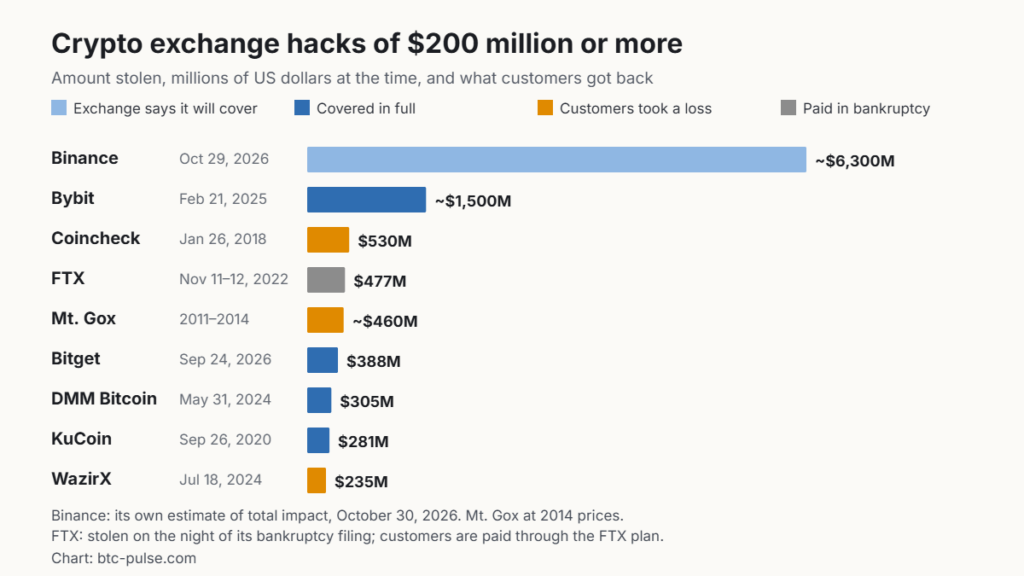
| Exchange | Date | Stolen (at the time) | What happened | Who was blamed | What customers got back |
|---|---|---|---|---|---|
| Binance | October 29, 2026 | about $6.3 billion (Binance’s estimate; about $3 billion frozen) | A compromised DevOps engineer’s laptop gave access to a service container used to submit withdrawals, Binance’s first findings say | Not confirmed; TRM Labs and ZachXBT point to North Korea | Binance says it will cover all losses from SAFU and company funds; withdrawals paused |
| Bybit | February 21, 2025 | about $1.5 billion (about 401,000 ETH) | Attackers tricked signers during a transfer from offline (cold) storage to a wallet used for withdrawals | North Korea (FBI) | Full; reserves refilled within 72 hours |
| Coincheck | January 26, 2018 | about $530 million | Keys to an online wallet holding 523 million XEM, the NEM network’s token, were stolen | Not confirmed | Repaid in yen at ¥88.549 per XEM, about 81 cents on the dollar, per Finance Magnates |
| FTX | November 11–12, 2022 | about $477 million | SIM-swap theft, in which attackers hijack a phone number to take over accounts, on the night of the bankruptcy filing | Three people indicted in a SIM-swap case in January 2024; Elliptic linked it to FTX | Through the FTX bankruptcy plan |
| Mt. Gox | 2011 to February 2014 | about 850,000 BTC (about $460 million at 2014 prices) | Years of theft from hot wallets, which are connected to the internet; about 200,000 BTC later found | Two Russian nationals charged by the US Justice Department on June 9, 2023 | Partial, still being repaid |
| Bitget | September 24, 2026 | about $388 million (first reported as $351.6 million) | A flaw in a third-party security product let attackers forge withdrawals | Bitget’s CEO suspects North Korea; no government attribution yet | Full, from Bitget’s protection fund |
| DMM Bitcoin | May 31, 2024 | about $305 million | A wallet software vendor was compromised | North Korea (FBI and Japanese police) | Full, but the exchange closed |
| KuCoin | September 26, 2020 | about $281 million | Hot-wallet keys were stolen | Lazarus Group (Chainalysis) | Full; $236 million recovered and the rest covered by KuCoin’s insurance fund |
| WazirX | July 18, 2024 | about $235 million | A multisig wallet, which needs several approvals to move funds, run with custody firm Liminal was taken over | North Korea suspected; no government attribution | About 85% under a Singapore court plan approved October 13, 2025 |
Scroll the table horizontally to see all columns.
Other notable exchange hacks below $200 million:
- BitMart, December 4, 2021: about $196 million from two hot wallets; BitMart said it would compensate users with its own funds.
- Poloniex, November 10, 2023: estimates of $114 million to $130 million; owner Justin Sun said the exchange would fully reimburse affected funds.
- Bitfinex, August 2, 2016: 119,756 BTC, about $72 million, taken from multisig wallets run with BitGo. Bitfinex cut every customer balance by 36% and later repaid the cut through BFX tokens. Ilya Lichtenstein pleaded guilty to laundering the coins on August 3, 2023.
Binance: an attacker drained hot wallets on Ethereum, Bitcoin and Tron starting at 20:24 UTC on October 29, 2026. Binance paused deposits and withdrawals, said it found no evidence of a private key leak, and promised a full post-mortem. Tether, Circle and others froze about $3 billion of the stolen assets. Our Binance hack report has the timeline and latest updates.
Bybit: the FBI attributed the attack to a North Korean group it calls TraderTraitor on February 26, 2025. Bybit kept withdrawals open and refilled about 447,000 ETH within 72 hours using loans and deposits. The exchange later sued North Korea and the Lazarus Group and won an asset freeze in August 2026.
Bitget: the first estimate was $351.6 million on September 24–25, 2026. Bitget’s own incident page put the final figure at about $388 million on October 20, 2026. Funds moved from 12 hot and warm wallet addresses, used for day-to-day withdrawals, on 11 blockchains. Bitget said private keys were not compromised and cold wallets were unaffected; reports by Mandiant and SlowMist broadly matched its account of the attack path. Withdrawals came back in phases from September 28 to October 2, 2026. Part of the stolen funds later passed through Wasabi’s CoinJoin, a mixing method that obscures where coins came from, AMLBot found.
Why it matters: in the Bybit and Bitget hacks, customers lost nothing because the exchange had the reserves to absorb the loss, and Binance has promised the same. That depends on the exchange, not on any legal guarantee.
The biggest crypto exchange collapses
Customers of failed exchanges have waited up to 12 years for repayment, and QuadrigaCX users expected about 17% back, according to EY figures reported on November 6, 2020.
| Company | Failed | What customers got back | Status on October 30, 2026 |
|---|---|---|---|
| Mt. Gox | February 28, 2014 | Repayments in bitcoin and bitcoin cash started July 5, 2024 | Deadline extended to October 31, 2027 |
| QuadrigaCX | January 31, 2019, after its founder died on December 9, 2018 | About C$39.1 million for at least C$224.3 million of claims, about 17% (EY, per Decrypt on November 6, 2020) | Final payout not confirmed |
| Celsius | July 13, 2022 | $2.53 billion of a planned $2.73 billion first distribution paid by August 27, 2024; this is the share paid out, not recovery against claims | Emerged from bankruptcy on January 31, 2024; distributions continue |
| Voyager | July 5, 2022 | About 35% initially expected (May 17, 2023) | Latest figure found is that 35% estimate |
| FTX | November 11, 2022 | 105% of November 2022 dollar claims for main customer classes after five rounds | Fifth round began July 31, 2026 |
| BlockFi | November 28, 2022 | Administrator sought court approval for a 100% final distribution after selling FTX claims (July 23, 2024) | Final distribution proposed; completion not confirmed |
Scroll the table horizontally to see all columns.
FTX’s “more than 100%” needs context. Claims were set in dollars at November 2022 prices, when bitcoin was valued at about $16,871 in FTX’s claims schedule. A customer who held 1 BTC got back about 105% of that dollar amount, roughly a fifth of bitcoin’s $82,007 close on October 18, 2026. Small claims, grouped in a separate “convenience” class, were paid at 120%.
Celsius shows why the terms matter. On January 4, 2023, Judge Martin Glenn ruled that about $4.2 billion in Earn deposits belonged to Celsius, because its terms of use transferred ownership to the company. Those customers became unsecured creditors, who have no claim on specific assets and are paid after secured lenders. Our guide to stablecoin yield covers who holds custody of yield deposits and what happens if withdrawals are paused.
Mt. Gox is still not finished. In a notice dated October 16, 2026, the trustee said a Tokyo court had approved the fourth one-year extension, because many creditors had still not completed the process. Wallets linked to Mt. Gox held about 34,388 BTC as of October 20, 2026, according to Arkham.
What happens to your crypto if an exchange goes bankrupt or is hacked
If an exchange goes bankrupt, customers usually become creditors and wait for a court plan; no US government program insures crypto held there.
- Withdrawals freeze. The exchange stops withdrawals and files for bankruptcy, under Chapter 11 or Chapter 7 in the US or under local rules abroad.
- The terms of use decide ownership. If they transfer title to the exchange, as Celsius’s did, your coins become company property and you become an unsecured creditor.
- Claims are usually fixed in dollars on the filing date. FTX valued claims at November 2022 prices, so customers did not share in bitcoin’s later rise.
- You have to file a claim. Courts set a deadline for claims, and payouts usually require identity checks. Use only the court-appointed administrator’s website, since fake claim portals have targeted creditors.
- Payouts take years. Mt. Gox failed in 2014 and is still paying; FTX’s first distribution came in February 2025, more than two years after its collapse.
- After a hack, nothing is guaranteed. No federal law requires a crypto exchange to repay customers after a hack. Recovery depends on the exchange’s reserves and on whether stolen funds can be frozen, as KuCoin’s $236 million recovery showed.
How much crypto was stolen in 2025 and 2026
Attackers took more than $3.41 billion in 2025, Chainalysis reported on December 18, 2025, and $2.68 billion in 2026 through September, according to CertiK.
| Period | Amount stolen | Source |
|---|---|---|
| 2025 | more than $3.41 billion | Chainalysis (December 18, 2025) |
| 2025, North Korea alone | at least $2.02 billion | Chainalysis |
| January–June 2026 | $1.32 billion in 344 incidents | CertiK (July 17, 2026) |
| July–September 2026 | $1.26 billion in 247 incidents | CertiK (October 2, 2026) |
| 2026 through September | $2.68 billion | CertiK (October 2, 2026) |
| October 29, 2026, Binance alone | about $6.3 billion | Binance (October 30, 2026) |
Scroll the table horizontally to see all columns.
Chainalysis counts thefts from platforms and personal wallets. CertiK counts hacks, exploits and scams across crypto. CertiK’s year-to-date total of $2.68 billion is higher than its half-year and quarterly figures as first published, which add up to $2.58 billion; btc-pulse.com uses the latest total.
September 2026 was the worst month of the year through September at $768.5 million, CertiK said. Binance’s October 29 hack, at about $6.3 billion, is more than twice CertiK’s whole 2026 total through September, so 2026 will almost certainly pass 2025’s record once October is counted.
What protects customers in the US
No federal program insures crypto held on a US exchange, according to an FDIC fact sheet from July 28, 2022, and SIPC’s own website.
- FDIC: covers bank deposits only, not crypto, and not a crypto company’s failure.
- SIPC: protects up to $500,000, including $250,000 in cash, when a member brokerage fails. It does not cover hacks or price drops, and it “does not protect any digital or crypto asset that does not qualify as a ‘security,'” its site says.
- Exchange funds: Binance’s SAFU (Secure Asset Fund for Users) fund holds 15,000 BTC, converted by February 12, 2026, and Binance says it will restore it to $1 billion if its value falls below $800 million. After its October 29, 2026 hack, Binance said it will cover losses from SAFU and its own funds. Bitget’s protection fund covered its 2026 loss. These are company promises, not insurance.
- Proof of reserves: a report showing an exchange holds at least as much crypto as customers have deposited. Binance, OKX and Bitget publish one about monthly; Kraken publishes periodic accountant-reviewed statements. A report is a snapshot and doesn’t prove the exchange can pay everyone at once. See OKX’s 47th proof-of-reserves report for an example.
- Federal law: the CLARITY Act, which would set rules for crypto markets, stalled in the Senate on September 15, 2026, when a cloture vote failed 49–50. The GENIUS Act, signed July 18, 2025, protects stablecoin holders if an issuer fails, not exchange customers.
- Self-custody: coins held in a wallet the owner controls are not part of an exchange’s bankruptcy estate, but the owner carries the risk of lost keys. A watch-only wallet lets an owner track those coins without exposing keys.
What to watch next
Five open items will shape this record, starting with Binance’s post-mortem on its October 29, 2026 hack.
- Binance: the post-mortem, the final loss after frozen funds, when withdrawals reopen, and any official attribution.
- CertiK’s fourth-quarter report, for the full 2026 total.
- Bitget: whether the FBI or another government formally attributes the September 24, 2026 hack.
- FTX: further distributions as disputed claims are settled; no date has been set.
- Mt. Gox: repayments under the new October 31, 2027 deadline.
FAQ
What is the biggest crypto exchange hack ever?
Binance’s, on October 29, 2026, with an estimated impact of about $6.3 billion. The previous record was Bybit’s, about $1.5 billion in ether on February 21, 2025, which the FBI attributed to North Korea.
What is the largest crypto hack of any kind?
Also Binance’s. Before it came Bybit’s $1.5 billion in 2025 and the Ronin Network bridge hack in March 2022, about $625 million, which US officials tied to North Korea’s Lazarus Group.
How did Bybit get hacked?
Attackers tricked the people approving a routine ether transfer from cold storage into signing a transaction that handed them control of the wallet. The FBI blamed North Korea’s TraderTraitor group.
Was FTX hacked?
Yes. About $477 million was taken by SIM-swap on November 11–12, 2022, separate from its collapse, and three people were indicted in January 2024.
What happens to my crypto if an exchange gets hacked?
It depends on the exchange. Binance has promised to cover its 2026 losses in full. Bybit, Bitget, KuCoin and DMM Bitcoin covered their customers in full, while WazirX users got about 85% back and Bitfinex cut every balance by 36% before repaying it through BFX tokens. No federal law requires a crypto exchange to repay customers after a hack.
Can you get your crypto back after an exchange hack?
Only if the exchange covers the loss or the stolen funds are frozen. KuCoin recovered $236 million of about $281 million in 2020 and covered the rest from its insurance fund.
What happens to my crypto if an exchange goes bankrupt?
You usually become a creditor and wait for a court-approved plan. FTX customers got about 105% of their November 2022 dollar claims after five payment rounds, the latest starting July 31, 2026, and QuadrigaCX users expected about 17%.
Is crypto on an exchange insured?
Not by the government. FDIC insurance doesn’t cover crypto, and SIPC generally doesn’t cover crypto that isn’t a security. Some exchanges keep their own reserve funds, such as Binance’s 15,000 BTC SAFU fund.
Who is behind most exchange hacks?
North Korean groups account for the largest share of value stolen: at least $2.02 billion in 2025, about 59% of that year’s total, according to Chainalysis. The FBI tied the Bybit and DMM Bitcoin hacks to North Korea.
Has Mt. Gox paid back its customers?
Partly. Repayments began on July 5, 2024, and the deadline was extended to October 31, 2027. Wallets linked to Mt. Gox held about 34,388 BTC as of October 20, 2026, according to Arkham.
Sources
- Bitcoin.com News: Binance releases first $6.3B hack findings (October 30, 2026)
- FBI: North Korea responsible for $1.5 billion Bybit hack (February 26, 2025)
- Bitget: security incident timeline (updated October 20, 2026)
- Elliptic: three individuals implicated in the $477 million FTX heist (January 2024)
- Decrypt: Mt. Gox pushes repayment deadline to 2027 (October 20, 2026)
- Bitcoin.com News: FTX fifth distribution (July 31, 2026)
- Morrison Foerster: Celsius Earn ruling (January 9, 2023)
- The Block: Chainalysis 2025 crypto theft report (December 18, 2025)
- Coin Insider: CertiK Q3 2026 hack losses (October 2, 2026)
- SIPC: what SIPC protects
This article is for informational purposes only and is not investment advice.