Last updated: October 29, 2026. Market data as of October 28–29, 2026.
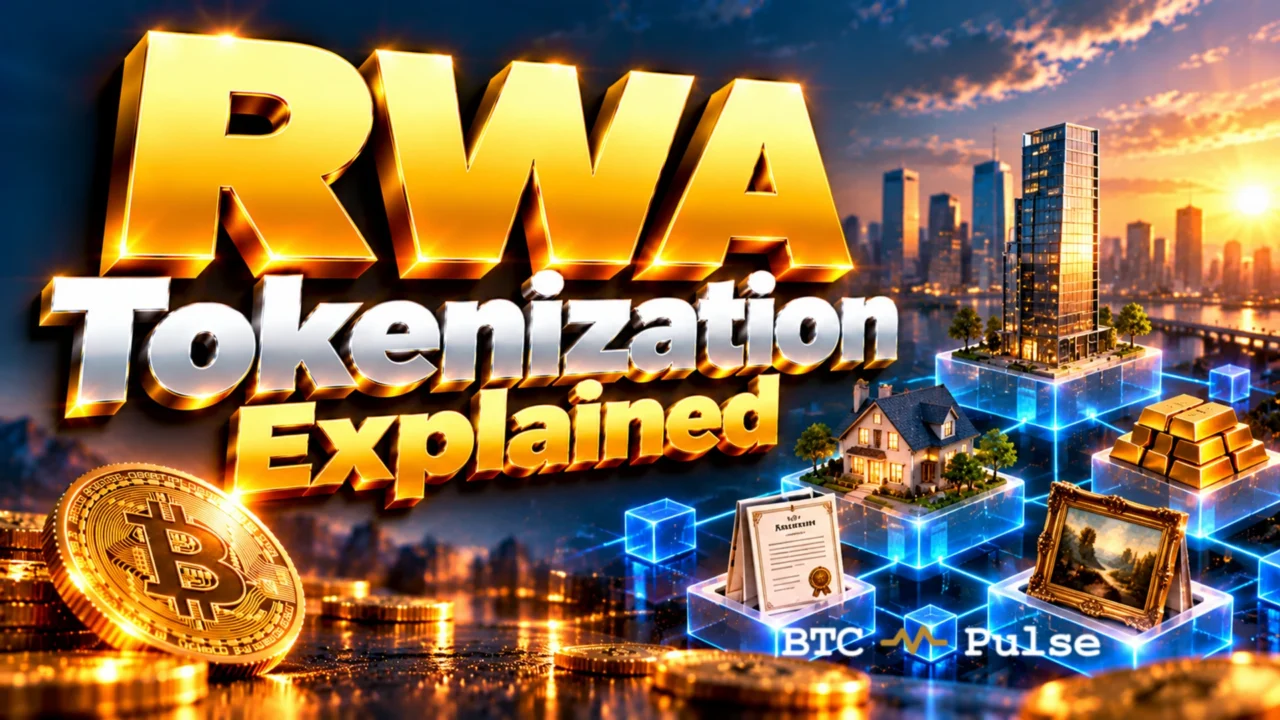
Short answer: RWA tokenization means putting a real-world asset on a blockchain as a token. Think Treasury bills, gold, loans or company shares. The token is a digital record of your claim on that asset. On October 28, 2026, about $39.3 billion of tokenized real-world assets sat on public blockchains, according to rwa.xyz. The biggest group is tokenized US Treasury funds at $14.5 billion. Most tokenized Treasury funds are open only to large or non-US investors. And a token is only as good as the legal claim behind it.
Key takeaways
- Market size: $39.30 billion on October 28, 2026, per rwa.xyz. Stablecoins are counted separately.
- Treasuries lead: tokenized US Treasury funds hold $14.54 billion (37%). Private credit (loans made through crypto platforms) is $8.15 billion, commodities $5.23 billion, stocks $3.74 billion.
- Biggest single token: Tether Gold (XAUT) at $3.03 billion. The largest Treasury products are Ondo’s USDY ($2.38 billion) and Circle’s USYC ($2.37 billion).
- Yield trails T-bills: tokenized Treasury funds paid 3.65% on average (7-day APY, last week’s yield annualized). The 3-month T-bill was at 4.15% on October 27, 2026.
- Access is limited: most tokenized Treasury funds exclude US retail investors.
What is RWA tokenization?
A real-world asset (RWA) is anything that exists off the blockchain: bonds, gold, loans, real estate, company shares. Real-world asset tokenization means a company holds the asset and issues tokens on a blockchain that represent ownership or a claim on it.
The token itself is just an entry on a blockchain. What gives it value is the legal setup behind it:
- An issuer: a fund or a special-purpose company (SPV) that owns the asset.
- A custodian: a bank that holds the asset. For BlackRock’s BUIDL, that’s BNY.
- A transfer agent: keeps the official list of who owns what. For BUIDL, that’s Securitize.
- A whitelist: only wallets that passed identity checks (KYC) can hold or receive the token.
So RWA crypto tokens are not like bitcoin. You can’t send most tokenized Treasuries to any wallet you want. The issuer decides who can hold them.
Why tokenize real-world assets?
The promise is speed and access, not a new kind of return:
- Faster transfers. Tokens can move between approved wallets any time the blockchain runs, often in minutes. Buying in or cashing out with the fund still usually follows business days.
- Use as collateral. Some crypto exchanges accept tokenized Treasuries as collateral for trades. Firms earn interest instead of parking idle cash.
- Smaller slices. In theory a token can split an asset into tiny pieces. In practice, many products still have high minimums.
What this means for you: a tokenized Treasury still pays roughly what Treasuries pay, minus fees. The blockchain changes how it moves, not what it earns.
RWA tokens vs “RWA coins”
You’ll see lists of “RWA crypto coins,” like ONDO. Those are project tokens. Holding ONDO doesn’t give you a claim on Treasuries. A fund token like OUSG does, if you’re eligible to hold it. The two move for different reasons.
Watch out: a coin with “RWA” in its pitch can still be a pure bet on a project, with no asset behind it.
How big is the RWA market in 2026?
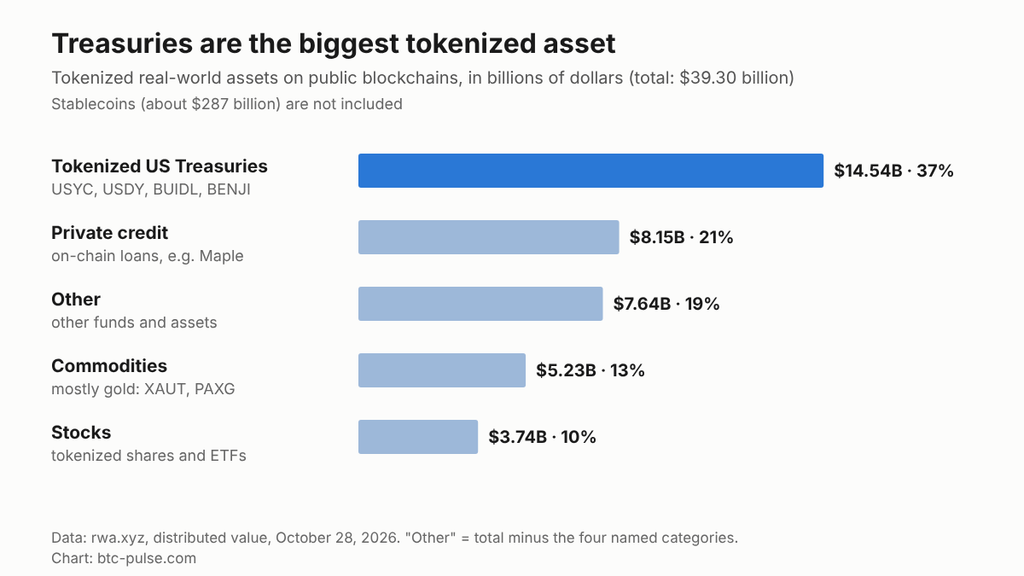
| Category | Value on public blockchains | 30-day change | Biggest products |
|---|---|---|---|
| US Treasury funds | $14.54 billion | −0.5% | Ondo USDY, Circle USYC, BlackRock BUIDL |
| Private credit | $8.15 billion | +1.3% | Maple’s syrupUSDC token |
| Commodities | $5.23 billion | +4.2% | Tether Gold (XAUT), Paxos Gold (PAXG) |
| Stocks | $3.74 billion | +17.8% | bStocks, Ondo, xStocks |
| Other funds and assets | $7.64 billion | n/a | |
| All tokenized assets | $39.30 billion | +1.4% |
Scroll the table horizontally to see all columns.
“Distributed” value on rwa.xyz (tokens that can move on public blockchains), October 28–29, 2026. “Other” is the total minus the four named categories.
Watch out: you’ll also see much bigger numbers. rwa.xyz shows $370.67 billion of “represented” assets, but most of that is records kept on a company’s own ledger, like Figure’s $24 billion of home-equity loans. Those tokens don’t trade freely. When you compare headlines, check which number they use.
For scale, all stablecoins together were about $287 billion on the same day by rwa.xyz’s count. DefiLlama, which counts more coins, showed about $300 billion. Either way, tokenized assets are still about one-seventh the size of stablecoins.
Gold is the main commodity on-chain, but other metals are starting to follow: in October 2026, Hyperscale Data tokenized 5,000 ounces of silver.
The largest tokenized Treasury products
A tokenized Treasury fund is a regular fund that holds T-bills. Its shares are issued as tokens on a blockchain. You earn the fund’s interest, minus fees.
| Product | Manager | Size | What it is |
|---|---|---|---|
| USDY | Ondo Finance | $2.38 billion | Note issued by an Ondo company (SPV), not a fund |
| USYC | Circle | $2.37 billion | Tokenized fund |
| BUIDL | BlackRock (with Securitize) | $2.19 billion | Tokenized money market fund |
| iBENJI and BENJI | Franklin Templeton | $1.71 billion and $0.68 billion | Two versions of Franklin’s on-chain fund |
| JLTXX | JPMorgan | $0.79 billion | Tokenized fund |
| WTGXX | WisdomTree | $0.76 billion | Tokenized money market fund |
Scroll the table horizontally to see all columns.
Data: rwa.xyz, October 29, 2026.
BlackRock BUIDL launched on March 20, 2024, on Ethereum. It holds cash, Treasury bills and repurchase agreements (overnight loans backed by Treasuries). It aims to keep each token at $1 and pays interest as new tokens every month. It now runs on 9 blockchains, with Solana the largest. BUIDL’s assets fell about 2.7% in the 30 days to October 29, 2026, per rwa.xyz.
BlackRock has also launched money market funds aimed at stablecoin reserves. See our report on BlackRock’s tokenized cash funds.
Who can actually buy tokenized assets?
Most tokenized Treasury funds are not open to ordinary US investors.
| Product | Who can buy | Minimum |
|---|---|---|
| BlackRock BUIDL | Qualified purchasers via Securitize | $5 million at launch |
| Ondo OUSG | Qualified purchasers who are also accredited investors | set by issuer, check terms |
| Ondo USDY | Non-US persons only | set by issuer, check terms |
| Robinhood stock tokens | EU and EEA customers, not US | none stated |
| Kraken xStocks | Select non-US markets | none stated |
Scroll the table horizontally to see all columns.
What the terms mean:
- Accredited investor: usually $1 million+ net worth, not counting your home, or $200,000+ in yearly income.
- Qualified purchaser: generally $5 million+ in investments.
- Reg D and Reg S: SEC exemptions that let a fund skip public registration if it sells only to wealthy or non-US buyers. BUIDL and OUSG use Reg D; USDY uses Reg S.
What this means for you: most US retail investors who hold Treasuries or gold do it through a brokerage account or an ETF. Tokenized versions mainly serve crypto firms, funds and non-US investors for now.
Worked example: tokenized Treasury vs a T-bill
Say you have $10,000 to park for a year. This is a math example only: most of these funds won’t take $10,000 from a US buyer.
- 3-month T-bill at 4.15% (Treasury’s coupon-equivalent rate on October 27, 2026): about $415 a year, if rates stay the same.
- Average tokenized Treasury fund at 3.65%: about $365 a year.
- BUIDL at 3.74%: about $374 a year (for comparison only; its minimum is far above $10,000).
The gap is roughly $40 to $50 on $10,000. Part of it is fund fees, part is how each yield is measured. You pay for 24/7 transfers and on-chain use. Without those features, a plain T-bill paid more on the same day.
Compare that with a stablecoin: a regular stablecoin pays you nothing, because the issuer keeps the interest. Our guide to stablecoin yield explains where on-chain dollar yield comes from and what it risks.
What can go wrong?
The token is only as good as the legal claim behind it. Three cases, plus one line of fine print:
- No real claim. On June 30, 2025, Robinhood gave EU customers “OpenAI tokens.” On July 2, 2025, OpenAI said they were not OpenAI equity and that it didn’t approve any transfer. Robinhood said the exposure came through a stake in a separate company (SPV).
- Loans go bad. Goldfinch, an on-chain private credit protocol, began winding down in June 2026 after borrower defaults. Depositors reported stalled withdrawals and estimated their real losses at about 70%, The Defiant reported on June 22, 2026.
- Withdrawals freeze. In November 2025, Stream Finance froze withdrawals after an outside manager lost $93 million. Its xUSD token fell 77%, Decrypt reported. It wasn’t a strict RWA, but it shows how a “stable” token can break.
- $1 is a goal, not a guarantee. BlackRock says BUIDL “seeks” a stable $1 per token but may not always achieve it.
Watch out: trading may run 24/7, but redemptions often work only on business days. The issuer can also freeze or block tokens, and a smart-contract bug can delay transfers.
What are the US rules?
- SEC staff statement, January 28, 2026: a tokenized security is still a security. SEC staff sorted tokenized securities into three types: issued by the company itself, held by a custodian on your behalf, or synthetic (a separate product that tracks the price). Your rights differ by type. The statement gave no new relief.
- Nasdaq, March 18, 2026: the SEC approved Nasdaq’s rule to trade tokenized versions of Russell 1000 stocks and major index ETFs on the same trading screen as regular shares, with the same ticker. Settlement stays T+1 (one business day). Nasdaq said in March 2026 that it aims to start in the first half of 2027.
- SEC Innovation Exemption, September 17, 2026: a conditional exemption for venues that trade tokenized exchange-listed (NMS) stocks. It lasts 5 years and caps symbols and volume. Tokens must give the same rights as the underlying shares.
- GENIUS Act, signed July 18, 2025: covers payment stablecoins, not tokenized funds.
- CLARITY Act: the broader crypto market bill passed the House in July 2025. On September 15, 2026, a Senate vote to start debate on it failed. If it isn’t passed before the new Congress in January 2027, it must be reintroduced.
Tokenized stock holdings are growing fast from a small base: $3.74 billion, up 17.8% in 30 days, though monthly transfer volume fell about 87%. For one company’s plan, see our report on Cantor and Securitize’s blockchain IPOs.
How big could it get?
Forecasts vary a lot, so treat them as guesses, not data:
- McKinsey (June 20, 2024): about $2 trillion by 2030, with a range of $1 trillion to $4 trillion.
- BCG and ADDX (September 22, 2022): $16.1 trillion by 2030.
- Standard Chartered and Synpulse (June 27, 2024): $30.1 trillion of demand by 2034.
Today’s $39 billion is far below all of them. Reaching even McKinsey’s low case would take roughly 25 times more tokenized assets in about four years, though each forecast defines the market differently.
Quick checklist
- Check the number: “distributed” ($39 billion) or “represented” ($371 billion)?
- Read who can buy: many products exclude US retail investors.
- Find the legal claim: fund share, SPV note or a synthetic tracker?
- Compare the yield: with a T-bill or a money market fund, after fees.
- Check redemption: who redeems, how fast, and on which days.
FAQ
What does RWA mean in crypto? RWA stands for real-world asset: something that exists off the blockchain, like a Treasury bill, gold, a loan or a stock. In crypto, it usually means a token that represents a claim on that asset.
How does RWA tokenization work? An issuer, usually a fund or an SPV, holds the asset with a custodian and issues tokens on a blockchain. A transfer agent keeps the official ownership record. Only wallets that passed KYC can hold most of these tokens.
How big is the RWA market? About $39.30 billion of tokenized assets were on public blockchains on October 28, 2026, according to rwa.xyz, not counting stablecoins. Tokenized US Treasury funds were the largest group at $14.54 billion.
What are tokenized Treasuries? Tokens that represent shares in a fund, or a note, backed by short-term US Treasury bills and cash. The largest on October 29, 2026 were Ondo’s USDY ($2.38 billion), Circle’s USYC ($2.37 billion) and BlackRock’s BUIDL ($2.19 billion), per rwa.xyz.
What is BlackRock BUIDL? BUIDL is BlackRock’s tokenized money market fund, launched on March 20, 2024. It holds cash, Treasury bills and repurchase agreements, aims for $1 per token and had about $2.19 billion in assets on October 29, 2026, per rwa.xyz.
Can US retail investors buy tokenized Treasuries? Mostly not directly. BUIDL is sold to qualified purchasers with a $5 million minimum at launch, Ondo’s OUSG is only for qualified purchasers (generally $5 million+ in investments) and USDY is for non-US persons only.
What are examples of RWA crypto tokens? Tether Gold (XAUT) and Paxos Gold (PAXG) for gold; BUIDL, USYC and USDY for Treasuries; Maple’s syrupUSDC for private credit; and xStocks for tokenized shares.
Is a tokenized stock the same as owning the share? Not always. The SEC staff statement of January 28, 2026 splits tokenized securities into company-issued, custodial and synthetic types, and only some give you the same rights as the share itself.
Are tokenized assets safe? They carry the asset’s own risk plus extra layers: the issuer, the custodian, the smart contract and the redemption rules. Goldfinch depositors, for example, estimated their real losses at about 70% after borrower defaults in 2026.
Sources
- rwa.xyz: tokenized asset market overview, US Treasuries, private credit, commodities, stocks and BUIDL (October 28–29, 2026)
- US Treasury: daily Treasury bill rates (October 27, 2026)
- Business Wire: BlackRock launches its first tokenized fund, BUIDL (March 20, 2024)
- Blockonomi: how OUSG and USDY tokenize US Treasuries (May 9, 2026)
- Robinhood: stock tokens launch in the EU (June 30, 2025) and Business Wire: Kraken and Backed launch xStocks (May 22, 2025)
- CoinDesk: OpenAI warns tokenized equity sale on Robinhood is unauthorized (July 2, 2025)
- The Defiant: Goldfinch winds down (June 22, 2026) and Decrypt: Stream Finance stablecoin plunges 77% (November 2025)
- Morrison Foerster: SEC staff statement on tokenized securities (January 29, 2026), CoinDesk: SEC approves Nasdaq tokenized securities trading (March 18, 2026), American Banker: Nasdaq partners with Kraken on tokenized stocks (March 9, 2026) and SEC: Innovation Exemption for tokenized NMS stock (September 17, 2026)
- The Block: GENIUS Act signed (July 18, 2025) and DLA Piper: Senate fails to advance the CLARITY Act (September 2026)
- McKinsey: tokenizing assets (June 20, 2024), ADDX: BCG and ADDX report (September 22, 2022) and Standard Chartered: $30.1 trillion tokenized RWA market by 2034 (June 27, 2024)
This article is for informational purposes only and is not investment advice.