Short answer: A Bitcoin futures ETF (like BITO) holds bitcoin futures contracts, while a spot ETF (like IBIT) holds real bitcoin. Spot funds are cheaper, at 0.25% a year for IBIT against 0.95% for BITO, and lost 2.6 points less over the year to September 30, 2026 (−26.8% vs −29.4%). Three other common types: leveraged ETFs aim for 2x bitcoin’s daily move, inverse ETFs aim for the opposite of it, and miner ETFs hold company stocks, not bitcoin. For long-term exposure to bitcoin itself, a low-fee spot ETF is the closest match.
Key takeaways
- Spot ETFs are the cheapest: 0.14% to 0.25% a year for most funds, against 0.75% to 2.75% for the other types.
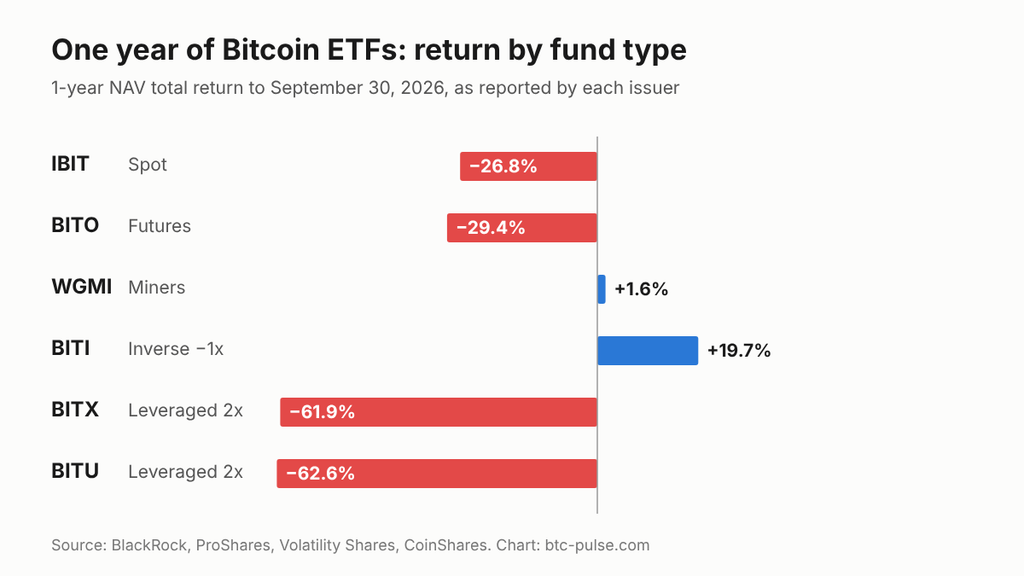
- The futures ETF lagged spot by 2.6 points over the year to September 30, 2026 (−29.4% for BITO vs −26.8% for IBIT), because of a higher fee and the cost of rolling contracts.
- Leveraged and inverse ETFs reset every day, so over a year they miss their target: the 2x funds lost about 62%, worse than the roughly 54% that twice IBIT’s 26.8% loss would suggest, and the inverse fund gained only 19.7%.
- Miner ETFs now behave partly like a tech fund. WGMI gained 1.6% in a year when IBIT lost 26.8%, helped by its AI data-center stocks.
Bitcoin ETF types at a glance
Spot ETFs are the cheapest way to track bitcoin; every other type adds futures costs, daily-reset leverage or stock-market risk.
| Type | Example | What it holds | Fee per year | 1-year return | Best for |
|---|---|---|---|---|---|
| Spot | IBIT (BlackRock) | Real bitcoin, held by a custodian | 0.25% | −26.8% | Long-term bitcoin exposure in a brokerage or retirement account |
| Futures | BITO (ProShares) | Bitcoin futures, mostly on the CME | 0.95% | −29.4% | Traders who use its options market; not a better long-term hold than spot |
| Leveraged 2x | BITX (Volatility Shares), BITU (ProShares) | Bitcoin futures (BITX); futures and swaps, contracts with banks that pay the return of spot Bitcoin ETFs (BITU) | 2.75% / 0.98% | −61.9% / −62.6% | Short-term trades of a day to a few days |
| Inverse −1x | BITI (ProShares) | Short bitcoin futures | 1.01% | +19.7% | Short-term hedges against a bitcoin drop |
| Miner | WGMI (CoinShares) | About 30 mining and AI data-center stocks | 0.75% | +1.6% | Investors who want crypto-linked stocks, not bitcoin itself |
Data as of October 7, 2026. Fees and 1-year NAV total returns (change in the fund’s net asset value with payouts reinvested) to September 30, 2026: issuer websites (BlackRock, ProShares, Volatility Shares, CoinShares). Holdings: issuer websites, as of October 5, 2026 (WGMI) and October 6, 2026 (others).
Other, smaller niches exist, such as covered-call income funds and funds that hold both bitcoin and ether; this guide covers the five most common types.
What is a spot Bitcoin ETF?
A spot ETF buys bitcoin and keeps it with a custodian (a regulated firm that stores the coins), so its price follows bitcoin minus a small yearly fee. Each share represents a set amount of bitcoin, which shrinks slightly each year as the fund sells bitcoin to pay its fee. Twelve spot funds hold bitcoin in the US (a 13th, Hashdex’s DEFI, is closing). As of October 5, 2026, they held about 1.29 million BTC, and BlackRock’s IBIT alone held 62% of that. Our spot Bitcoin ETF tracker lists every fund with its fee and holdings and is updated every Friday.
Pros: the lowest fees (Morgan Stanley’s MSBT charges 0.14%, most others 0.20% to 0.25%), deep liquidity and no futures contracts to roll (see the next section). Cons: you don’t hold the private keys (the codes that control the coins), and fees still vary: Grayscale’s GBTC charges 1.50%, or $150 a year per $10,000.
Spot funds keep attracting new money: in September 2026 they took in a net $2.65 billion. Smaller funds struggle to compete: Hashdex’s DEFI announced in August 2026 that it will close, the first US spot Bitcoin ETF to shut down.
What is a Bitcoin futures ETF?
A futures ETF doesn’t own bitcoin; it holds contracts that track bitcoin’s price. BITO, the oldest and best-known, held about 81% of its exposure in CME (Chicago Mercantile Exchange) bitcoin futures as of October 6, 2026, plus futures listed by Coinbase and a small swap. The contracts are cash-settled, which means no bitcoin ever changes hands.
Futures expire, so the fund sells each contract before expiry and buys the next one, a process called rolling. When later contracts cost more than near ones (a market state called contango), every roll costs a little money. That cost tends to be large when futures trade at a big premium, as often happens in bull markets, and smaller in a falling market.
Over the year to September 30, 2026, BITO returned −29.4% against −26.8% for IBIT. About 0.7 points of that gap is the higher fee; the rest mostly reflects roll costs, net of interest earned on the fund’s cash collateral. BITO started trading on October 19, 2021, as the first US Bitcoin ETF of any kind, more than two years before spot funds were allowed. It managed about $1.74 billion as of October 6, 2026.
The catch is distributions. BITO pays out money most months, and ProShares lists a 12-month yield of 38.2% as of August 31, 2026 (payouts over the past 12 months divided by the share price). That isn’t extra return: each payout lowers the fund’s value. In a taxable account the payouts can be taxed in the year you receive them, even if you reinvest them, while a spot ETF you buy and hold creates almost no taxable income until you sell. Inside an IRA this difference disappears. Check the fund’s tax documents or ask a tax professional before choosing one for a taxable account.
How do leveraged Bitcoin ETFs work?
Leveraged ETFs such as BITX (2.75% total yearly fee) and BITU (0.98%) aim to return twice bitcoin’s move for one day. They rebalance every day, so over longer periods the result can drift far from “2x bitcoin.”
A simple example shows why. Suppose bitcoin rises 10% on Monday and falls 10% on Tuesday:
| Start | After the +10% day | After the −10% day | Total | |
|---|---|---|---|---|
| Bitcoin | $100 | $110 | $99 | −1% |
| 2x ETF | $100 | $120 | $96 | −4% |
| −1x ETF | $100 | $90 | $99 | −1% |
Bitcoin lost 1%, but the 2x fund lost 4%, not 2%. The −1x fund lost 1% too, even though bitcoin fell: in a choppy market an inverse fund can lose money in both directions. The choppier the market, the bigger these gaps; in a steady trend the math can work in the holder’s favor instead.
The past year was choppy. In the year to September 30, 2026, IBIT lost 26.8%, so “2x” would suggest a loss near 54%. BITX lost 61.9% and BITU 62.6%. Part of that gap is futures roll costs and fees (BITX charges 2.75% a year); the rest is the daily-reset effect shown above.
More leverage is coming. In early October 2026 the SEC cleared 3x leveraged Bitcoin and Ether ETPs (exchange-traded products, a wider category that includes ETFs). The same daily-reset math applies to them, with bigger swings.
What is an inverse Bitcoin ETF?
An inverse ETF such as BITI (1.01%) aims to return the opposite of bitcoin’s daily move: if bitcoin falls 3% today, BITI should rise about 3%. As of October 6, 2026, it did this with a short position in CME bitcoin futures. ProShares also runs SBIT, which targets −2x and loses value to the daily reset even faster.
In the year to September 30, 2026, IBIT lost 26.8%, yet BITI gained only 19.7%. The daily reset and the fee took about a quarter of the move. When bitcoin rises for long stretches, an inverse fund keeps losing, so it works as a short-term hedge rather than a long-term position.
What is a Bitcoin miner ETF?
A miner ETF owns shares of companies, not BTC. WGMI (CoinShares, 0.75%, about $260 million as of October 2, 2026) holds about 30 stocks. Its largest holdings were Cipher Digital, Nebius, CoreWeave, Hut 8 and Keel Infrastructure as of October 5, 2026.
Several of those names are AI cloud and data-center companies, not pure miners. On August 18, 2026, WGMI made that shift official: CoinShares now describes it as a fund of “Bitcoin Mining and Digital Power Companies,” a group that includes AI data centers. Miners that moved into AI hosting likely drove much of the gap: WGMI gained 1.6% in a year when IBIT lost 26.8%. It also means a miner ETF is no longer a clean bet on bitcoin: it moves with tech stocks as much as with BTC.
What to know before you buy
- Where to buy: any US brokerage account, by ticker. Some brokers block leveraged and inverse funds or ask you to confirm that you understand the risks first.
- Trading hours: ETFs trade only while the stock market is open, but bitcoin trades around the clock, so prices can jump at the open.
- Retirement accounts: spot funds can sit in an IRA or a 401(k) that offers them. Leveraged and inverse funds are often not allowed there.
- Daily checks: leveraged and inverse funds are built for positions you watch every day, not for buying and forgetting.
Which Bitcoin ETF type fits you?
- You want to own bitcoin for years without a wallet: a spot ETF with a low fee. A 0.15% fund costs $15 a year per $10,000; a 1.50% fund costs $150.
- You want to trade a move over a day or two: a leveraged or inverse ETF, sized small and checked daily.
- You want to hedge bitcoin you already own for a short time: an inverse ETF, closed once the risk passes.
- You believe in mining and AI infrastructure companies: a miner ETF, as part of your stock portfolio.
- You want monthly payouts: BITO makes them, but they are not extra return. Each payout lowers the fund’s value and can be taxed.
FAQ
What is the difference between a spot and a futures Bitcoin ETF? A spot ETF holds real bitcoin. A futures ETF holds futures contracts and rolls them every month, which can add cost when later contracts are more expensive. Spot ETFs are also cheaper: 0.25% for IBIT against 0.95% for BITO.
What was the first Bitcoin ETF in the US? ProShares’ BITO, a futures ETF, started trading on October 19, 2021. The first spot Bitcoin ETFs started trading on January 11, 2024.
Is there an inverse Bitcoin ETF? Yes. ProShares’ BITI targets −1x bitcoin’s daily move, and SBIT targets −2x. Both reset daily, so they suit short-term hedges rather than long holds.
Can I hold a leveraged Bitcoin ETF long term? You can, but the result can differ widely from 2x bitcoin’s move. In the year to September 30, 2026, BITX and BITU lost about 62% while IBIT lost 26.8%.
Do Bitcoin miner ETFs hold bitcoin? No. They hold shares of mining and data-center companies. WGMI’s largest holdings include Cipher Digital, Nebius, CoreWeave and Hut 8.
Why does BITO pay such a high dividend? Its distributions are what the fund earns from its futures positions and from the cash it holds as collateral, paid out instead of kept in the share price. The payouts are not extra profit: the share price drops by the amount paid out.
Sources
- BlackRock, iShares Bitcoin Trust (IBIT): fee, 1-year return
- ProShares, BITO: fee, holdings, assets, yield, 1-year return
- ProShares, BITU and BITI: fees, holdings, 1-year returns
- Volatility Shares, BITX: fee, holdings, 1-year return
- CoinShares, WGMI: fee, assets, holdings, strategy change, 1-year return
- CoinShares, WGMI renamed Bitcoin Mining and Digital Power ETF: August 18, 2026 release
- Spot ETF holdings and fees: our spot Bitcoin ETF tracker (data from Farside Investors and Bitbo)
This article is for informational purposes only and is not investment advice.