
Last updated: November 4, 2026.
Short answer: A Bitcoin confirmation is a block added on top of the block that holds your transaction. One confirmation means your payment is in the blockchain; each new block adds one more. Blocks come about every 10 minutes, so 3 confirmations take about 30 minutes and 6 about an hour. Most US exchanges credit a bitcoin deposit after 2 or 3 confirmations, and 6 is the long-standing rule for large amounts.
Key takeaways
- 0 confirmations: your transaction is waiting in the mempool, the queue of unconfirmed transactions. It can still be replaced or dropped.
- Exchange rules: Coinbase lists 2 confirmations for bitcoin; Kraken and Gemini credit deposits after 3.
- Why 6: the Bitcoin white paper shows that an attacker with 10% of mining power has a 0.024% chance of reversing a payment after 6 blocks.
- Block time right now: blocks averaged about 10 minutes 15 seconds since the October 29, 2026 difficulty adjustment, according to mempool.space.
- Fees are low: on the morning of November 4, 2026, mempool.space recommended 1 satoshi per virtual byte even for the next block.
What is a Bitcoin confirmation?
A confirmation is proof that miners have built on top of your transaction. When you send bitcoin, your wallet broadcasts the transaction to the network. It waits in the mempool until a miner includes it in a block. At that moment it has 1 confirmation. When the next block is found, it has 2, and so on.
Each block contains a fingerprint (hash) of the block before it. To change your transaction, someone would have to redo the work for that block and every block after it, and then overtake the rest of the network. The more blocks on top, the more work that takes. This is why confirmations, not the moment you press “send,” decide when a payment is final.
Example: you send 0.01 BTC at 2:00 p.m. It lands in a block at 2:07 p.m. (1 confirmation). New blocks arrive at 2:15, 2:26 and 2:31 p.m., so by 2:31 p.m. your payment has 4 confirmations.
How long does a Bitcoin confirmation take?
About 10 minutes on average, but any single block can take one minute or an hour. Mining is a race of random guesses, so the gap between blocks varies. Every 2,016 blocks, roughly two weeks, the network adjusts mining difficulty to bring the average back toward 10 minutes.
| Confirmations | Average wait | Typical use |
|---|---|---|
| 0 | Seconds, but can be reversed | Small in-person payments, at the seller’s risk |
| 1 | About 10 minutes | Small payments between people who trust each other |
| 2 to 3 | About 20 to 30 minutes | Deposits at most US exchanges |
| 6 | About 1 hour | Large payments; the traditional standard |
| 100 | About 17 hours | Before miners can spend newly mined bitcoin |
Scroll the table horizontally to see all columns.
Times assume 10-minute blocks. Newly mined coins can’t be spent until 100 more blocks are added, a rule in Bitcoin’s code.
Current network conditions, according to mempool.space on November 4, 2026:
- Block height: 974,451 blocks.
- Average block time: about 10 minutes 15 seconds since the last difficulty adjustment on October 29, 2026. Difficulty rose 5.5% then, and mempool.space projected a 2.3% cut at the next adjustment around November 13, 2026.
- Waiting transactions: about 45,000 in the mempool, roughly 11 virtual megabytes.
- Recommended fee: 1 satoshi per virtual byte for the next block. A satoshi is 0.00000001 BTC.
How many confirmations do exchanges require?
Two or three for bitcoin at the largest US exchanges. Your deposit appears as “pending” until it reaches that number.
| Exchange | Confirmations for a BTC deposit | What it says |
|---|---|---|
| Coinbase | 2 | Lists 2 confirmations for bitcoin “to consider a transaction final” |
| Kraken | 3 | Credits bitcoin deposits “after three confirmations, which takes approximately 45 minutes” |
| Gemini | 3 | Bitcoin is “available in your account for trading after 3 confirmations,” typically in about 30 minutes |
Scroll the table horizontally to see all columns.
Sources: each exchange’s help page, checked November 4, 2026. Exchanges change these numbers without notice; check the deposit screen before you send.
Coinbase has lowered its requirements before: in April 2022 it cut the confirmations needed for several assets to speed up deposits. Exchanges set these numbers because a reversed deposit is their loss, not yours. Our list of the biggest crypto exchange hacks shows how much exchanges stand to lose.
Why 6 confirmations became the standard
Six blocks make a reversal very unlikely for any attacker without a large share of mining power. In section 11 of the Bitcoin white paper, Satoshi Nakamoto calculated the chance that an attacker who controls part of the network’s mining power could rewrite a payment after a given number of blocks.
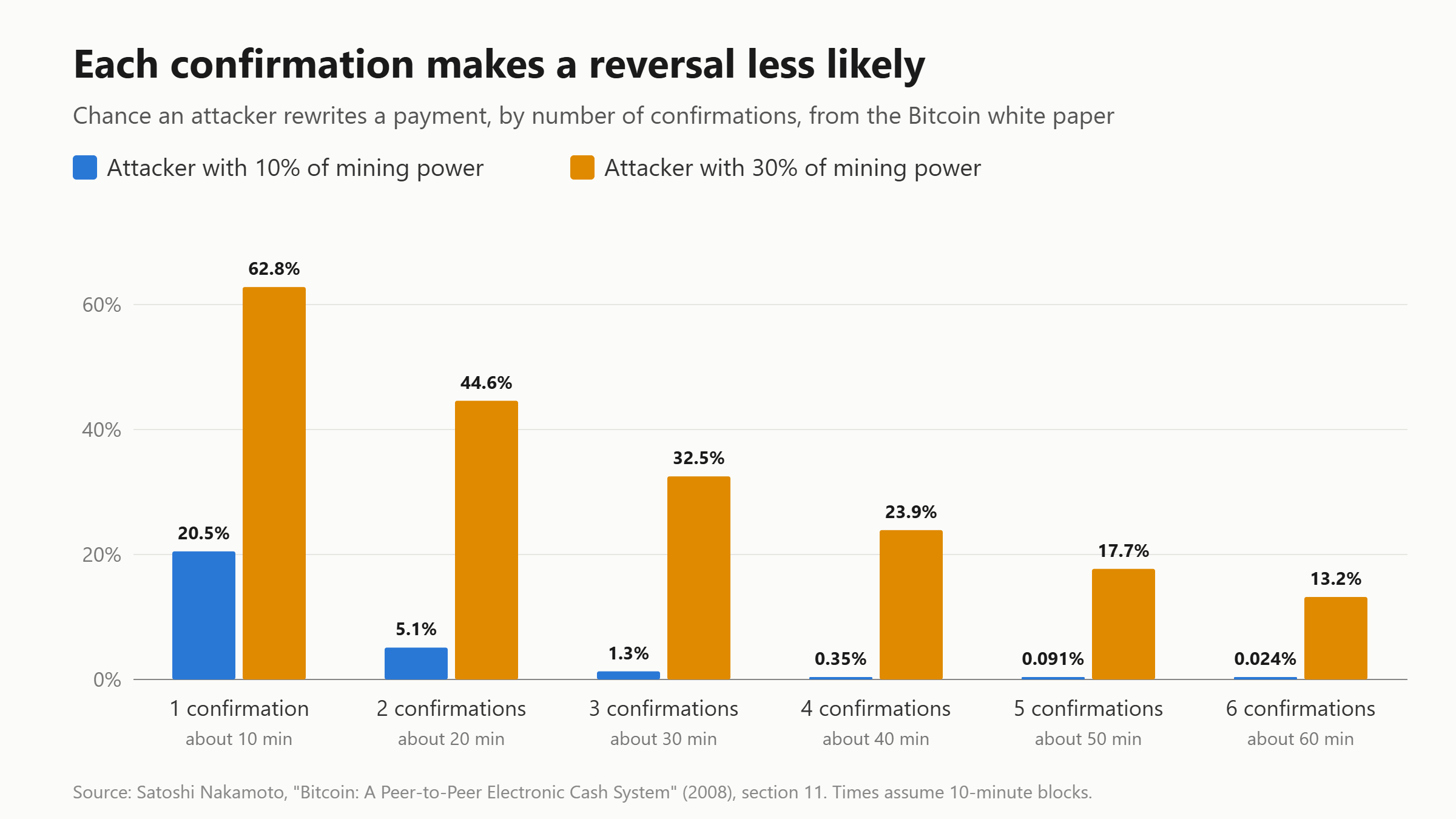
| Confirmations | Attacker with 10% of mining power | Attacker with 30% |
|---|---|---|
| 1 | 20.5% | 62.8% |
| 3 | 1.3% | 32.5% |
| 6 | 0.024% | 13.2% |
Scroll the table horizontally to see all columns.
The white paper also lists how many blocks it takes to push that chance below 0.1%: 5 blocks against an attacker with 10% of mining power, 24 blocks against 30%, and 340 blocks against 45%. An attacker with more than 50% can eventually overtake the network no matter how many confirmations you wait for, which is called a 51% attack.
What this means in practice: for Bitcoin, the 6-block rule is cautious. Gathering even 10% of Bitcoin’s mining power for an attack would take enormous resources. Exchanges therefore accept 2 or 3 confirmations for bitcoin, while for smaller blockchains, where renting enough mining power is cheaper, they often ask for far more.
Why is my Bitcoin transaction unconfirmed?
Usually because the fee is too low for current demand. Miners pick the transactions that pay the most per byte. When the mempool is full, low-fee transactions wait.
What you can do:
- Check the transaction on a block explorer such as mempool.space by pasting its ID. It shows the fee rate you paid and the rate needed for the next blocks.
- Speed it up with RBF (replace-by-fee) if your wallet supports it: the wallet resends the same payment with a higher fee.
- Use CPFP (child pays for parent) if you’re the receiver: you spend the unconfirmed coins with a high fee, which pulls both transactions into a block.
- Wait. Bitcoin Core nodes drop a transaction after two weeks in the mempool by default, and the coins then reappear in the sender’s wallet.
Watch out: a “transaction accelerator” site that asks you to send bitcoin to speed up a payment is a common scam. RBF and CPFP work from your own wallet.
Do you always need confirmations?
Not for small, everyday payments. The Lightning Network settles payments in seconds without waiting for blocks; only opening and closing a channel needs on-chain confirmations. Other blockchains work differently too: our Bitcoin vs Ethereum guide explains how Ethereum adds a block every 12 seconds and treats it as final after about 13 minutes.
What this means for you
- When you buy something or send to a friend: 1 confirmation is fine for small amounts; wait for 3 to 6 for larger ones.
- When you deposit to an exchange: expect 20 to 45 minutes before the coins can be traded, longer if blocks are slow.
- When you receive a large payment: don’t hand over goods or cash until 6 confirmations.
- When fees spike: check the mempool before sending; on quiet days, like November 4, 2026, the cheapest rate gets into the next block.
Quick checklist
- Copy your transaction ID from the wallet.
- Look it up on a block explorer and check the confirmation count.
- Compare it with what the receiver requires: 2 or 3 at most US exchanges, 6 for large payments.
- If it’s stuck, raise the fee with RBF or CPFP from your own wallet.
- Never pay a third party to “accelerate” a transaction.
FAQ
How many confirmations does a Bitcoin transaction need?
It depends on the receiver. Coinbase requires 2, Kraken and Gemini 3. Six confirmations, about one hour, is the traditional standard for large payments.
How long do 6 Bitcoin confirmations take?
About one hour on average, since blocks come about every 10 minutes. It can be faster or slower because block times vary.
What does 0 confirmations mean?
The transaction has been broadcast but isn’t in a block yet. It sits in the mempool and can still be replaced or dropped.
Can a confirmed Bitcoin transaction be reversed?
In theory, only by an attacker who redoes the work of every block on top of it. After 6 confirmations, an attacker with 10% of mining power has a 0.024% chance, according to the Bitcoin white paper.
Why is my Bitcoin transaction taking so long?
Usually the fee was too low for current demand, or a block took longer than usual. You can raise the fee with replace-by-fee if your wallet supports it.
Do more confirmations cost more?
No. You pay the fee once to get into a block. Every later confirmation is free; it only takes time.
Sources
- Satoshi Nakamoto: Bitcoin: A Peer-to-Peer Electronic Cash System (section 11, calculations)
- mempool.space: difficulty adjustment (November 4, 2026)
- mempool.space: recommended fees (November 4, 2026)
- mempool.space: Bitcoin explorer (block height and mempool, November 4, 2026)
- Coinbase Help: Confirmations
- Coinbase: Announcing new confirmation requirements (April 7, 2022)
- Kraken Support: Cryptocurrency deposit processing times (updated October 22, 2026)
- Gemini Support: How long until my crypto deposit reaches my account?
- Bitcoin Developer Guide: Transactions (coinbase maturity, fees)
This article is for informational purposes only and is not investment advice.