
Last updated: November 3, 2026.
Short answer: A stablecoin is a crypto token designed to stay worth $1. Most are backed by cash and short-term US Treasury bills held by the company that issues them, so approved customers can redeem each token for a dollar. Keeping that $1 price is called holding the peg. On November 3, 2026, all stablecoins together were worth about $308 billion, and two of them, Tether’s USDT and Circle’s USDC, made up 81% of that. The issuer keeps the interest on the reserves; you, as a holder, don’t get it.
Key takeaways
- Market size: about $308.3 billion on November 3, 2026, according to CoinMarketCap. USDT was $179.9 billion (58.4%) and USDC $71.3 billion (23.1%).
- Three main types: backed by cash and Treasuries (USDT, USDC, PYUSD), crypto-collateralized (DAI, USDS), and synthetic (USDe, which uses crypto plus a futures hedge).
- Who earns the yield: the issuer. A 3-month Treasury bill yielded 4.21% on November 2, 2026, so $1,000 held in a stablecoin earns its issuer about $42 a year.
- Stablecoins can break. USDC fell to about 87 cents on March 11, 2023, and TerraUSD collapsed to under 9 cents between May 9 and May 19, 2022.
- US rules are coming. The GENIUS Act, signed on July 18, 2025, requires 1:1 reserves and monthly disclosure. It takes effect no later than January 18, 2027.
How does a stablecoin stay at $1?
Most stablecoins hold a dollar of reserves for every token, and large customers can swap tokens for dollars at the issuer. That swap is what keeps the price near $1 on exchanges.
Here’s how it works for a cash-backed coin like USDC:
- A business sends $1 million to Circle and receives 1 million USDC.
- Circle puts the $1 million into cash and short-term Treasuries.
- When the business wants its money back, it returns 1 million USDC, Circle destroys the tokens and sends back $1 million.
If USDC trades at $0.99 on an exchange, a trader can buy it there and redeem it with Circle for $1.00, earning a cent per token. This is called arbitrage. That buying pushes the price back up. If it trades above $1, traders create new tokens at $1 and sell them. Most individual users never redeem directly; they buy and sell on exchanges, where that arbitrage keeps prices close to $1.
Crypto-backed and synthetic stablecoins work differently:
- Crypto-backed (DAI, USDS): users lock up more crypto than the stablecoins they borrow, for example $150 of ether for $100 of DAI. If the crypto falls too far, the system sells it to cover the loan.
- Synthetic (USDe): Ethena holds crypto and opens an equal short position (a bet that the price falls) in futures, so gains and losses cancel out. It also earns or pays the funding rate (a fee futures traders pay each other every few hours).
The largest stablecoins in November 2026
| Stablecoin | Issuer | What backs it | Market cap, November 3, 2026 | Share of market |
|---|---|---|---|---|
| USDT | Tether | Cash, Treasuries, plus some gold and bitcoin | $179.9 billion | 58.4% |
| USDC | Circle | Cash and Treasuries | $71.3 billion | 23.1% |
| USDS | Sky | Crypto loans plus other assets, including USDC and tokenized Treasuries | $6.5 billion | 2.1% |
| USDe | Ethena | Crypto plus a short futures hedge | $4.6 billion | 1.5% |
| DAI | Sky (formerly MakerDAO) | Crypto loans plus other assets, including USDC and tokenized Treasuries | $4.5 billion | 1.5% |
| USD1 | World Liberty Financial (reserves held by BitGo) | Cash and Treasuries | $3.8 billion | 1.2% |
| USDG | Paxos | Cash and Treasuries | $2.9 billion | 0.9% |
| PYUSD | Paxos, for PayPal | Cash and Treasuries | $2.8 billion | 0.9% |
| RLUSD | Ripple | Cash and Treasuries | $2.4 billion | 0.8% |
Scroll the table horizontally to see all columns.
Data: CoinMarketCap, November 3, 2026; USDS from DefiLlama, which CoinMarketCap’s stablecoin list doesn’t show. Tokenized funds such as BlackRock’s BUIDL are excluded. Trackers count some coins differently; DefiLlama, for example, puts USDT at $178.5 billion.
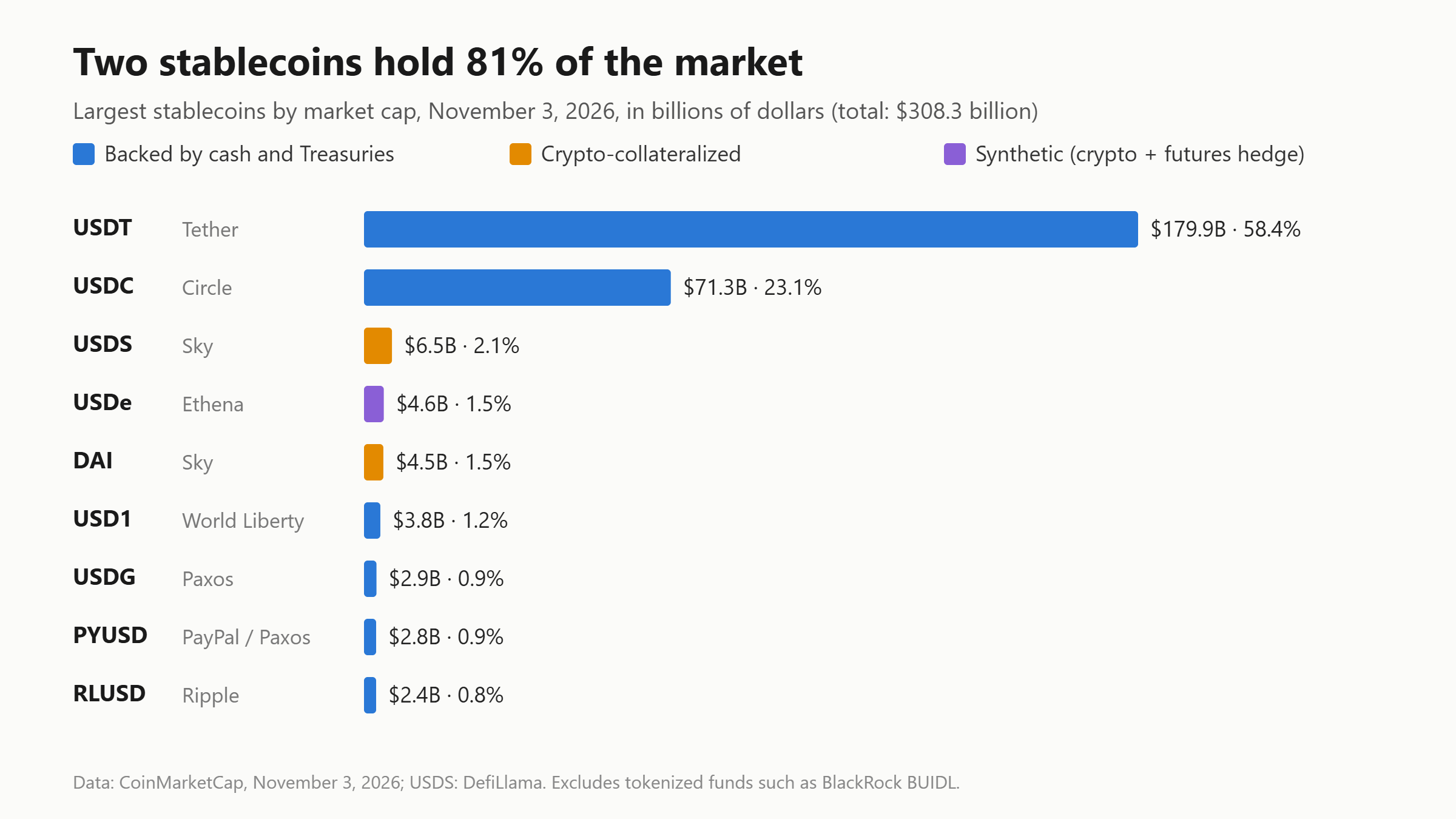
The market has barely grown in a year. DefiLlama showed about $302.9 billion on October 5, 2025, close to today’s $308 billion. Inside that total, the mix changed: USDe shrank from $14.8 billion to $4.6 billion, while newer coins like USD1 and USDG grew. USDC lost about $4 billion in redemptions in the 30 days to October 27, 2026, CryptoTicker reported from DefiLlama data.
What backs USDT and USDC?
Both hold mostly US government debt, but Tether also owns gold and bitcoin, while Circle keeps almost everything in Treasuries and cash. These are the latest reports we could check.
| Tether (USDT) | Circle (USDC) | |
|---|---|---|
| Report date | September 30, 2026 (quarterly attestation by BDO, published October 30: an accountant’s check of the reserves, not a full audit) | September 30, 2026 (monthly examination, published October 26) |
| Total reserves | $191.45 billion | $73.96 billion |
| Tokens outstanding | $183.47 billion | $73.88 billion |
| Treasury bills | $122.84 billion (64.2%) | $1.76 billion held directly (2.4%) |
| Money market fund | $62.47 billion in the Circle Reserve Fund (84.5%), which holds Treasuries and Treasury repos (overnight loans backed by Treasuries) | |
| Cash at banks | $9.50 billion (12.8%) | |
| Gold | $19.08 billion (10.0%) | None |
| Bitcoin | About 100,000 BTC, $8.37 billion (4.4%) | None |
| Other: repos, secured loans, equities, other investments | About $41.2 billion (21.5%) | |
| Excess reserves | $7.95 billion | About $78 million |
Scroll the table horizontally to see all columns.
Data: Tether Q3 2026 financial figures and reserves report; Circle USDC examination report for September 2026. Percentages are of total reserves. Tether counts the liability for issued USDT; Circle counts USDC in circulation.
Watch out: Tether’s gold and bitcoin can lose value fast. Its $7.95 billion cushion covered 4.3% of tokens outstanding on September 30, 2026, up from $4.11 billion on June 30. Tether valued its bitcoin at $83,621 per coin that day; at about $78,000 in early November, the same holding is worth roughly $0.6 billion less. USDT isn’t authorized under MiCA, the EU’s crypto rules, and Tether’s CEO has said the company won’t seek a license, according to our report on Tether’s MiCA decision.
Who earns the interest on stablecoins?
The issuer does. Reserves sit mostly in Treasury bills, and a 3-month bill yielded 4.21% on November 2, 2026, according to the US Treasury. Holders of cash-backed tokens get nothing from the issuer.
Worked example. You keep $1,000 in USDC for a year. At a 4.21% Treasury yield, the reserves behind your tokens earn about $42. Circle keeps that money, though it shares a large part with distribution partners like Coinbase. You still have $1,000. Across the whole $308 billion market, that’s roughly $13 billion a year at today’s rates, if all reserves were in 3-month bills.
This is why some exchanges offer “rewards” on stablecoins: they pass part of that income back to you. Once it takes effect, the GENIUS Act will ban issuers from paying interest just for holding, but rules for exchanges and other platforms are still being written. Our guide to stablecoin yield explains where those returns come from and what can go wrong.
When stablecoins lost their peg
A stablecoin is only as safe as what backs it and how fast you can redeem it. Three cases show the main risks.
| Date | Stablecoin | What happened | Lowest price |
|---|---|---|---|
| May 9 to May 19, 2022 | TerraUSD (UST) | Algorithmic coin (kept at $1 by a trading mechanism with its sister token LUNA, not by cash reserves); its peg broke and never came back | Below $0.09 |
| March 10 to March 13, 2023 | USDC | $3.3 billion of reserves were stuck at the failed Silicon Valley Bank; the peg returned after the US guaranteed SVB deposits | About $0.87 to $0.88 |
| October 10, 2025 | USDe | Price fell on Binance during a market crash, while it stayed near $1 on other venues | $0.65 on Binance |
Scroll the table horizontally to see all columns.
The lesson: cash-backed coins can wobble when a bank fails, and coins without real reserves can go to zero. A price on one exchange can also break while the coin holds elsewhere.
Can an issuer freeze your stablecoins?
Yes. Tether and Circle can freeze tokens at any address, and they do it after hacks. When Binance was hacked on October 29, 2026, Tether said it froze more than $1.5 billion of stolen USDT within 30 minutes, and Circle CEO Jeremy Allaire said Circle froze 823 million USDC. Frozen tokens can’t be moved, but freezing isn’t the same as giving the money back; our analysis of Tether’s Binance freeze explains the difference, and our Binance hack coverage has the full timeline. The same power means an ordinary user’s tokens can be frozen if they’re linked to a theft or a sanctions case.
What the GENIUS Act changes in the US
The GENIUS Act is the first US federal law for stablecoins. It was signed on July 18, 2025, as Public Law 119-27. Its main rules for payment stablecoins:
- 1:1 reserves in US dollars, insured deposits, Treasury bills maturing in 93 days or less, Treasury repos or government money market funds.
- Monthly public reports on reserves, checked by a registered accounting firm, with the CEO and CFO certifying them.
- Audited annual financial statements for issuers with more than $50 billion outstanding.
- No interest or yield paid by the issuer just for holding the coin.
- Start date: the earlier of January 18, 2027 or 120 days after final regulations.
Regulators are still writing the details. The Federal Reserve’s comment period on its two proposals closes 60 days after their publication in the Federal Register on September 29, 2026, so in late November; see our report on the Fed’s GENIUS Act proposals. No final GENIUS Act rule from the Fed had been published by early November.
What stablecoins are used for
- Trading crypto. Many crypto trades are priced in USDT or USDC, so traders park money in stablecoins between trades.
- Sending dollars. A USDC transfer on a fast network settles in seconds, any day of the week, often for a few cents.
- Holding dollars outside the US. In countries with high inflation, people use USDT as a digital dollar account.
- Apps on Ethereum and other blockchains. Lending and trading apps run on stablecoins. Ethereum held about $139.5 billion of stablecoins on November 3, 2026, according to DefiLlama. Our bitcoin vs Ethereum guide explains how the two networks differ.
What this means for you
- If you hold stablecoins, know that a stablecoin is not a bank deposit: it has no FDIC insurance. Cash-backed coins with frequent reserve reports are easier to check.
- If you’re offered a yield, ask who pays it and from what. Any yield carries risk, and a rate above Treasury yields means extra risk is being taken somewhere.
- If you send stablecoins, check the network. USDT on Tron and USDT on Ethereum are the same coin on different blockchains, and sending to the wrong network can lose your funds.
Quick checklist
- Check what backs the coin: cash and Treasuries, crypto, or a hedge.
- Find the issuer’s latest reserve report and its date.
- Compare the coin’s supply with the reserves (look for an excess).
- Ask who pays any yield you’re offered, and from what.
- Confirm the network before you send.
FAQ
What is a stablecoin in simple terms?
A crypto token built to stay worth $1. Most are backed by dollars and Treasury bills held by the issuer, who will swap tokens back for dollars. Bitcoin is not a stablecoin: its price moves freely.
Are stablecoins safe?
Safer than most crypto, but not risk-free. USDC fell to about 87 cents on March 11, 2023 when a bank holding its reserves failed, and TerraUSD collapsed between May 9 and May 19, 2022. Stablecoins aren’t FDIC-insured.
What is the biggest stablecoin?
Tether’s USDT, with a market cap of about $179.9 billion on November 3, 2026, or 58.4% of the market. USDC is second at $71.3 billion.
How do stablecoin companies make money?
They invest the reserves, mostly in Treasury bills, and keep the interest. At about 4.2% a year, every $1,000 of tokens earns the issuer about $42.
Do you earn interest on stablecoins?
Not from issuers of cash-backed coins; once the GENIUS Act takes effect, it will ban issuers from paying interest just for holding. Some platforms pay rewards from their own income, which carries its own risks.
What is the difference between USDT and USDC?
Both aim to stay at $1. USDC keeps its reserves in cash and Treasuries and reports monthly. USDT is larger, reports quarterly, and also holds gold and bitcoin.
Sources
- CoinMarketCap: Stablecoins by market cap (November 3, 2026)
- DefiLlama: Stablecoins (USDS and chain totals, November 3, 2026)
- Tether: Q3 2026 results, reserve buffer nearly $8 billion (as of September 30, 2026)
- Tether: Over $1.5 billion frozen after the Binance hack (November 2, 2026)
- Circle: USDC transparency and reserve reports (September 2026 examination)
- US Treasury: Daily Treasury par yield curve rates (3-month yield, November 2, 2026)
- Federal Reserve: Comment request on two GENIUS Act proposals (September 24, 2026)
- CryptoTicker: Stablecoin supply shrinks as USDC redemptions mount (October 28, 2026)
- Paxos: The GENIUS Act explained (reserve, disclosure and effective-date rules)
- Norton Rose Fulbright: Breaking down the GENIUS Act (no-interest rule)
- Axios: USDC loses its peg after SVB (March 11, 2023)
- DappRadar: TerraUSD hits $0.67 as its peg slips (May 2022)
- 21Shares: Why USDe stayed stable onchain but de-pegged on Binance
This article is for informational purposes only and is not investment advice.