Last updated: October 27, 2026. Market data as of October 26–27, 2026.
Short answer: DeFi (decentralized finance) means lending, trading and earning interest through blockchain programs called smart contracts. There’s no bank or broker in the middle. You connect a crypto wallet and deal with the code directly. On October 26, 2026, about $89 billion sat in DeFi apps, according to DefiLlama. That’s about half the 2021 peak. The tradeoff is simple: you hold your own funds, but if something breaks, there’s usually no one to call and no insurance.
Key takeaways
- Market size: about half the $177.49 billion DefiLlama recorded on November 9, 2021.
- Ethereum dominates: it holds about 55% of all DeFi value. Base, BNB Chain, Solana and Tron each hold 6–7%.
- Three big uses: staking (Lido, $22.7 billion locked), lending (Aave, $17.6 billion) and trading on decentralized exchanges ($6.66 billion traded in the 24 hours to October 27, 2026).
- Yields are modest now: on October 27, 2026, lending USDC on Aave paid about 3.8% a year and staking ETH through Lido about 2.3%.
- Risks are real: a single exploit at Kelp DAO on April 18, 2026 took about $292 million, weeks after attackers took about $280 million from Drift. In the next two days, DeFi’s total value fell $13.2 billion as users withdrew funds.
What is DeFi (decentralized finance)?
DeFi, short for decentralized finance, is a set of crypto apps that run on public blockchains instead of inside a company. The rules live in smart contracts: programs that hold money and follow their code automatically. No company runs the app day to day, though many still have admin keys that a small team controls.
Why people use it:
- Open to anyone with a wallet, with no account approval.
- Open 24/7, including weekends.
- Public code: anyone can check the rules and the money in each contract.
- Apps plug into each other: a token earned in one app can be used as collateral in another.
Here’s how it differs from a bank or an exchange like Coinbase:
| Bank or exchange | DeFi app | |
|---|---|---|
| Who holds your money | The company | You, in your own wallet, until you deposit into a contract |
| Account | Name, ID, approval | Just a wallet, usually no ID check |
| Hours | Business hours for many actions | 24/7 |
| If something goes wrong | Customer support, sometimes insurance | Usually nothing; transactions can’t be reversed |
| Fees | Set by the company | Network fee (often called gas) plus the app’s fee |
To use DeFi, you need a self-custody wallet (like MetaMask or Rabby), crypto in it and some of the chain’s coin to pay network fees. You then “approve” an app to use your tokens. That approval step matters. Our guide to token approvals explains how to check and revoke them.
Watch out: a fake site can look exactly like Uniswap or Aave. One bad approval can empty your wallet.
How big is DeFi in 2026?
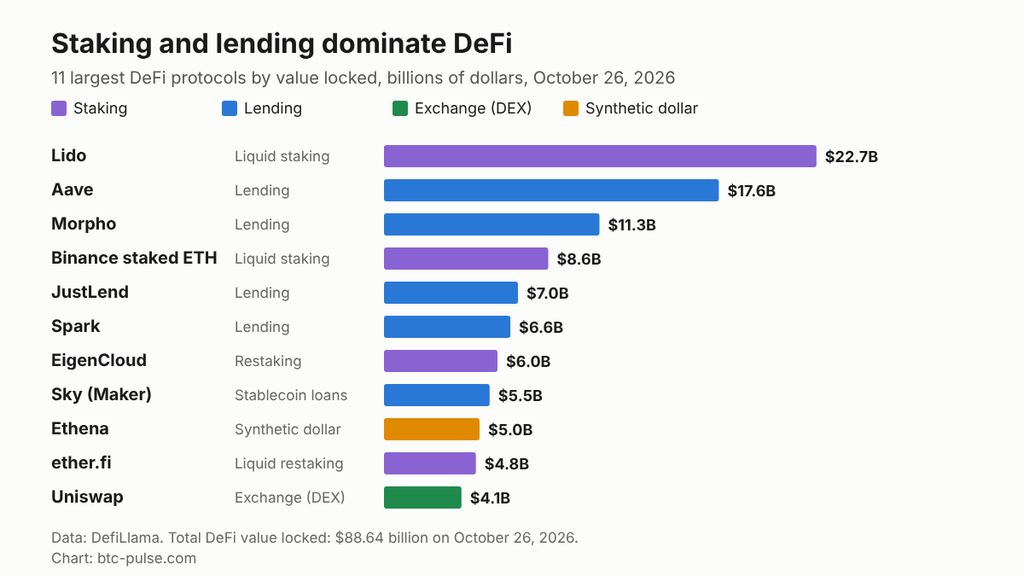
Total value locked (TVL) is the money deposited in DeFi contracts. It’s the standard size measure. It rises and falls with crypto prices, so it shrinks when ETH drops even if nobody leaves.
| Date | DeFi TVL | Source |
|---|---|---|
| November 9, 2021 | $177.49 billion (2021 peak) | DefiLlama |
| December 20, 2022 | $38.5 billion | DefiLlama |
| October 26, 2026 | $88.64 billion | DefiLlama |
News reports citing DefiLlama put DeFi near $178 billion again in early October 2025 and just over $70 billion in June 2026, CoinDesk and Cointelegraph reported. Those reports use different DefiLlama settings, so they aren’t directly comparable with the figures in the table.
By chain on October 26, 2026: Ethereum $48.5 billion (about 55%), Base $6.0 billion, Solana $5.7 billion, BNB Chain $5.5 billion, Tron $5.4 billion and Bitcoin $4.3 billion, per DefiLlama.
How DeFi lending works
You deposit crypto into a lending pool and earn interest from borrowers. Borrowers must lock up collateral (crypto held as security) worth more than they borrow.
Aave is the biggest example. Rates move constantly, based on how much of the pool is borrowed.
- Lending USDC on Aave (Ethereum): about 3.8% to 3.9% a year (variable) on October 27, 2026, per Aavescan and TradingStrategy.
- Borrowing USDC on Aave: about 4.5% to 4.6% a year on the same day.
Worked example: you lend $1,000 of USDC at 3.8%. After a year you’d earn about $38, if the rate held. A borrower taking $1,000 for a year at 4.5% would pay about $45.
What liquidation means
If a borrower’s collateral falls in value, the app sells it to repay the loan. That’s a liquidation.
Aave tracks this with a health factor: collateral value times its liquidation threshold (the share of the collateral’s value that counts toward the loan, for example 80%), divided by debt. Below 1.0, the loan can be liquidated.
Worked example (based on Aave’s help pages): you lock $10,000 of ETH with an 80% threshold and borrow $6,000. Your health factor is $10,000 × 0.80 ÷ $6,000 = 1.33. If your ETH collateral drops to $7,500 in value (a 25% fall), the health factor hits 1.0. Any further drop lets liquidators sell part of your collateral at a discount.
Watch out: liquidations happen fast in crashes. On October 10–11, 2025, $19.16 billion of leveraged positions (trades made with borrowed money) were liquidated in 24 hours, the largest ever, according to CoinGlass data reported by MoneySense. CoinGlass tracks centralized exchanges, so DeFi losses come on top.
For where the interest on dollar tokens comes from, see our guide to stablecoin yield.
How decentralized exchanges (DEXs) work
A DEX lets you swap one token for another straight from your wallet. Instead of matching buyers and sellers like a stock exchange, most use a pool of two tokens and a formula that sets the price.
People who deposit tokens into these pools are called liquidity providers. They earn a share of every trade’s fee.
- Uniswap v3 fee tiers: 0.05%, 0.30% and 1%. A $1,000 swap in a 0.30% pool costs $3 in pool fees, plus the network fee.
- Volume: all DEXs traded $6.66 billion in the 24 hours to October 27, 2026, and $213 billion over 30 days, per DefiLlama. Uniswap handled $2.03 billion of that day’s volume, about 30%.
- Growing share: DEX spot volume hit a record 24% of centralized-exchange volume in July 2026, up from 17% a year earlier, The Block reported.
Impermanent loss, in numbers
If you provide liquidity and prices move, you end up with less than if you’d just held the two tokens. This is called impermanent loss. Fees can offset it, but not always.
Say you deposit $1,000 of ETH and $1,000 of USDC into a 50/50 pool:
| ETH price change | If you just held | In the pool | Difference |
|---|---|---|---|
| −50% | $1,500 | $1,414 | −5.7% |
| +50% | $2,500 | $2,449 | −2.0% |
| +100% | $3,000 | $2,828 | −5.7% |
| +200% | $4,000 | $3,464 | −13.4% |
Our calculation for a standard 50/50 pool, before trading fees. Concentrated pools like Uniswap v3, where providers pick a narrow price range, can lose more.
Liquid staking, restaking and synthetic dollars
- Liquid staking: you stake ETH to help secure Ethereum and get a token back (like Lido’s stETH) that you can still use. Lido held 9.67 million ETH on October 27, 2026, and stETH paid about 2.3% a year, per Lido’s estimate.
- Restaking: EigenCloud (formerly EigenLayer) lets staked ETH secure other services for extra rewards and extra risk. It held $6.0 billion on October 26, 2026.
- Synthetic dollars: Ethena’s USDe aims to stay at $1 by holding crypto and betting against its price at the same time, not by holding bank reserves. It held $5.0 billion.
- Stablecoins: dollar tokens are the fuel of DeFi. All stablecoins together were worth about $300 billion on October 26, 2026, per DefiLlama.
What this means for you: ETH staking pays about 2.3% and USDC lending about 3.8%. Yields far above those usually come from leverage, new reward tokens or riskier loans.
What are the risks of DeFi?
The biggest DeFi losses have come from code bugs, manipulated price data and bridges. Bridges are apps that move tokens between blockchains. They hold huge pools of funds, so they’re prime targets.
| Incident | Date | Loss | What broke |
|---|---|---|---|
| Kelp DAO bridge | April 18, 2026 | about $292 million | Bridge exploit; stolen tokens used as collateral to borrow elsewhere |
| Drift (Solana) | April 1, 2026 | about $280 million | Attacker took over the app’s admin controls |
| Balancer | November 3, 2025 | about $128 million | Rounding error in pool math, across 8 chains |
| Cetus (Sui) | May 22, 2025 | $223 million | Math bug in a shared code library |
| Mango Markets | October 11, 2022 | about $110 million | Price feed manipulation |
After the Kelp DAO exploit, total DeFi value fell from $99.5 billion to $86.3 billion in 48 hours. Users pulled money from lenders like Aave, CoinDesk reported. Bad price data is another weak spot. Our guide to crypto oracles explains how price feeds fail.
Across all of crypto, hackers stole more than $3.41 billion in 2025, Chainalysis said. The biggest single theft, about $1.5 billion from Bybit on February 21, 2025, hit a centralized exchange, not DeFi. Across all of crypto, CertiK counted $1.26 billion stolen in July–September 2026 (about $870 million after frozen and returned funds), Coin Insider reported.
Other risks to know:
- Bad approvals and fake sites: signing a malicious approval can drain your wallet.
- Admin keys (special control rights): some apps can be paused or changed by a small team.
- Depegs: a “stable” token can lose its $1 value.
- No insurance: there’s no FDIC or SIPC coverage in DeFi.
Is DeFi legal? US rules and taxes
Using DeFi is legal in the US. The rules for DeFi apps themselves are still unsettled.
- Taxes still apply. Swapping one token for another is generally a taxable sale under IRS rules that treat digital assets as property.
- No DeFi 1099 for now. An IRS rule would have made the websites you use to reach DeFi apps report users on Form 1099-DA. Congress repealed it, and President Trump signed the repeal on April 10, 2025. Custodial brokers, such as centralized exchanges, still report sales on Form 1099-DA.
- CLARITY Act stalled. The crypto market-structure bill, which would set which agency oversees crypto, passed the House 294–134 on July 17, 2025. A Senate vote to start debate failed 49–50 on September 15, 2026. See what the CLARITY Act would change.
- GENIUS Act: signed July 18, 2025, covers payment stablecoins. Rules to put it into effect were still being written in 2026.
What this means for you: keep your own records. No one will send you a tax form for DeFi swaps.
Quick checklist
- Test with a small amount: if you try a new app, use only what you can afford to lose.
- Check the address: open apps from a bookmark, not from ads or messages.
- Review approvals: revoke ones you no longer use.
- Know your liquidation price: if you borrow, work out where your health factor hits 1.0.
- Track every swap: you’ll need the records for taxes.
FAQ
What is DeFi in simple terms? DeFi is lending, borrowing, trading and earning interest through blockchain programs instead of banks. You use a crypto wallet and deal directly with the code.
How much money is in DeFi? About $88.64 billion on October 26, 2026, according to DefiLlama. That’s about half the $177.49 billion DefiLlama recorded on November 9, 2021.
Is DeFi safe? It carries risks that banks don’t: code bugs, hacks, price-feed attacks and no deposit insurance. Large protocols have still lost hundreds of millions, such as Cetus, which lost $223 million on May 22, 2025.
Can you lose money in DeFi? Yes. You can lose money through hacks, liquidations, impermanent loss, depegs or a malicious approval, and there is no FDIC or SIPC insurance.
Is DeFi legal in the US? Yes, using DeFi apps is legal in the US. Taxes still apply, and the rules for DeFi apps themselves are unsettled while the CLARITY Act is stalled in the Senate.
How do people earn yield in DeFi? Mainly by lending, staking or providing liquidity. On October 27, 2026, lending USDC on Aave paid about 3.8% a year, and staking ETH through Lido about 2.3%. Higher rates usually mean more risk, and you can lose money.
What is a DeFi crypto token? A coin issued by a DeFi app, such as Aave’s AAVE or Uniswap’s UNI. Holders usually vote on the app’s rules. Owning one is a bet on that app, not a deposit that earns interest.
What is the difference between DeFi and crypto exchanges? On an exchange like Coinbase, the company holds your money and you get customer support. In DeFi, you keep custody in your own wallet, but mistakes and losses usually can’t be reversed.
Do you pay taxes on DeFi? Yes. Swaps and sales are generally taxable in the US even though DeFi apps don’t send a Form 1099-DA. You’re responsible for tracking them.
Sources
- DefiLlama: DeFi dashboard, chains, DEX volume and stablecoins (October 26–27, 2026)
- CoinDesk: DeFi’s $55B plunge (November 26, 2025) and Cointelegraph: DeFi TVL falls 39% in 2026 (June 24, 2026)
- TradingStrategy: Aave V3 USDC rates, Aavescan: Aave V3 Ethereum USDC rates (October 27, 2026) and Aave: liquidations help page
- Uniswap docs: fees, Lido (October 27, 2026)
- The Block: DEX to CEX spot volume ratio hits record (August 3, 2026)
- Bloomberg Government: Drift hit by $285 million exploit (April 2, 2026), CoinDesk: DeFi TVL drops more than $13 billion after Kelp DAO hack (April 20, 2026), The Block: Cetus restarts after $223 million exploit (June 8, 2025), How the $128M Balancer exploit happened (November 2025) and The Defiant: Mango Markets convictions overturned (May 2025)
- The Block: Chainalysis 2025 crypto theft (December 18, 2025), Coin Insider: $1.26 billion lost to hacks in Q3 2026 (October 1, 2026) and MoneySense: record liquidations, October 10, 2025
- House Ways and Means: President signs resolution overturning the IRS DeFi broker rule (April 10, 2025), IRS: Form 1099-DA instructions and IRS: digital assets
- Orrick: the CLARITY Act stalls in the Senate (October 2, 2026)
This article is for informational purposes only and is not investment advice.